
Why understanding the relationship between Thinking → Experience → Feeling can transform your personal life, leadership journey, business decisions, and professional success.
Introduction: Is It Really the Experience That Makes You Feel?
We often hear the advice, “Experience is the best teacher.” But have we ever stopped to question whether experience alone determines how we feel, react, and perform? Two people can face exactly the same situation and walk away with completely different feelings. One sees rejection as failure, while another sees it as an opportunity to improve. One doctor sees a difficult clinical case as a threat to confidence, while another sees it as an opportunity to investigate further.
What creates this difference? It is often not the experience itself, but the thinking that comes before, during, and after the experience.
This understanding introduces a powerful life and business philosophy: Thinking → Experience → Feeling. When we understand this chronology early, we stop allowing circumstances to control our emotions and start developing the ability to influence our responses.
1. Why Does Thinking Come Before Experience?
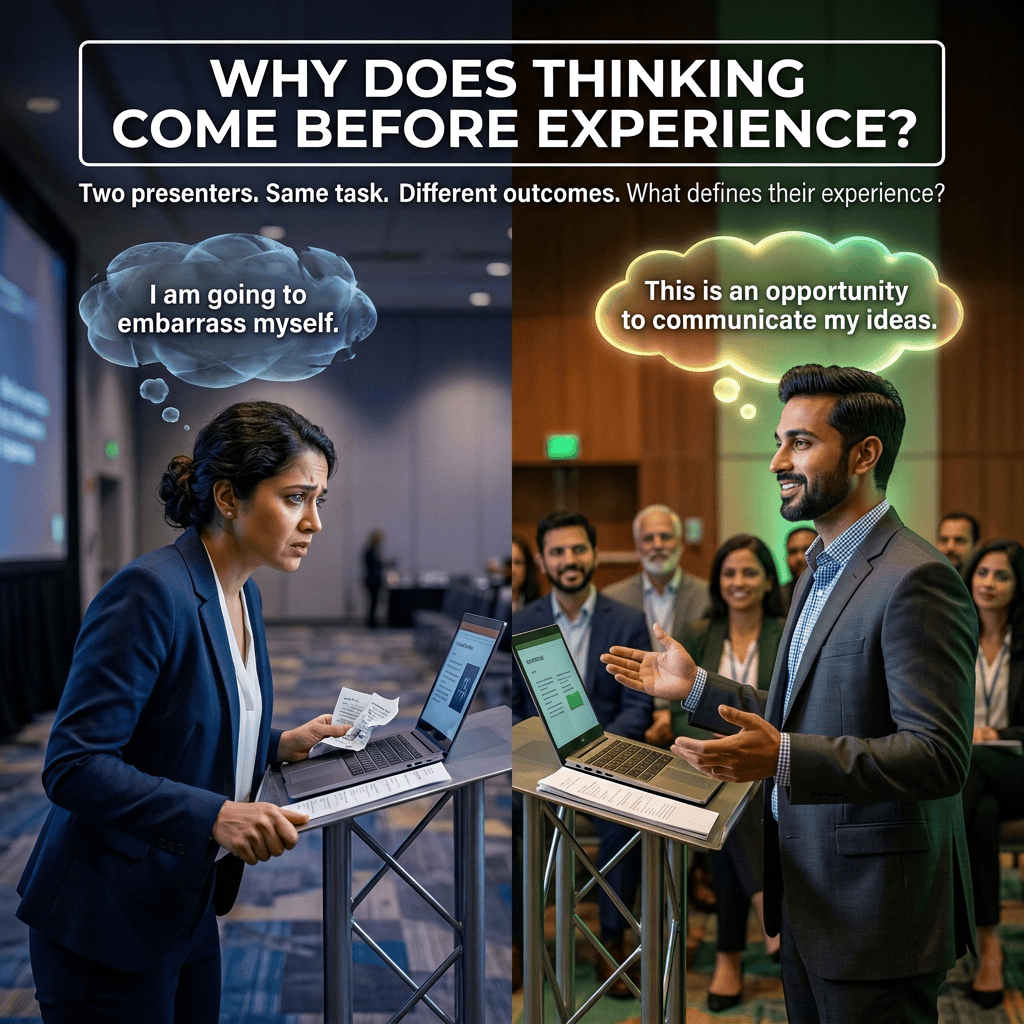
Every experience is first interpreted through our thoughts, expectations, beliefs, and assumptions. Before entering a meeting, starting a business, treating a patient, or having a difficult conversation, our mind has already created an expectation about what might happen.
Imagine two employees preparing for the same presentation. One thinks, “I am going to embarrass myself.” The other thinks, “This is an opportunity to communicate my ideas.” The presentation may be identical, but their confidence, body language, attention, and eventual feelings can be very different.
Our thinking acts like a lens through which we see reality. The lens does not necessarily change the external situation, but it influences what we notice, how we interpret it, and how we respond.
This is why the quality of our thinking influences the quality of our experience, which subsequently influences our feelings.
2. The New Framework:
Thinking → Experiencing → Feeling
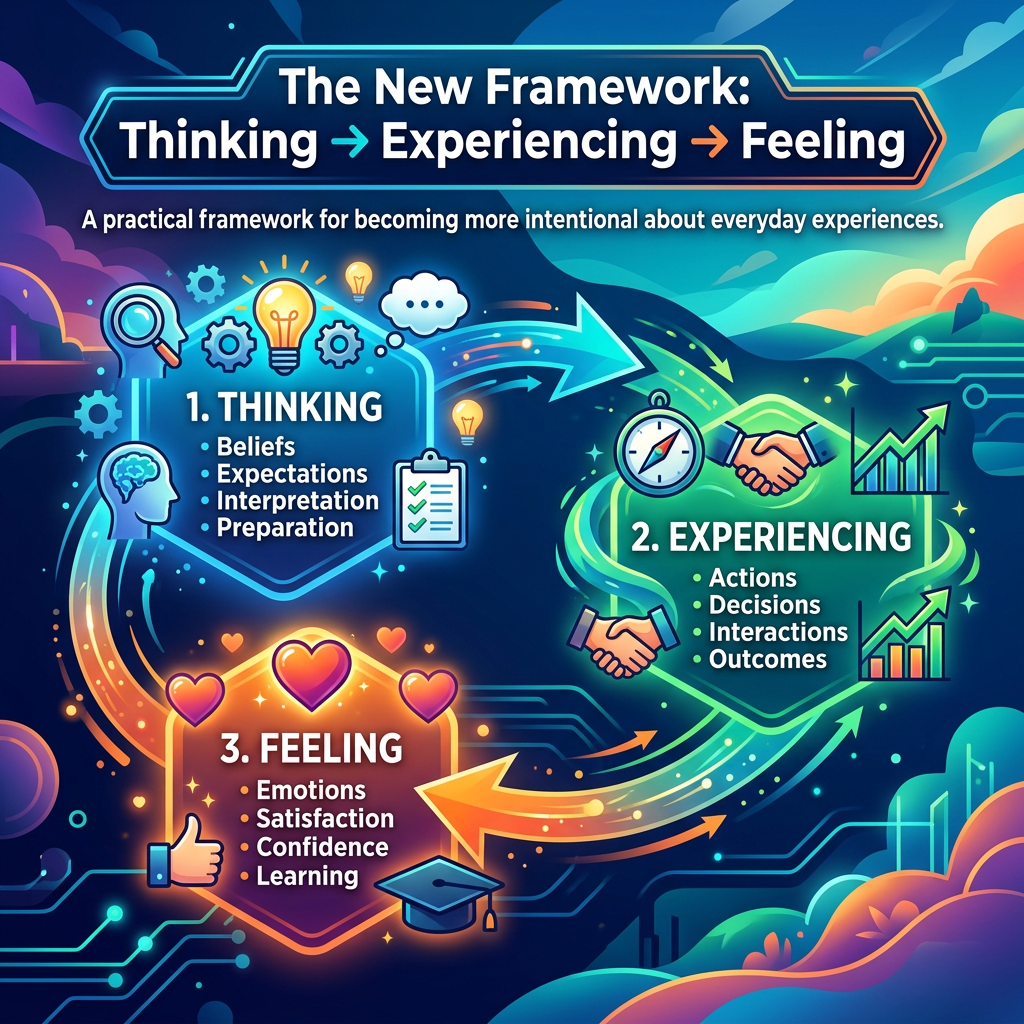
1. THINKING
Beliefs • Expectations • Interpretation • Preparation
2. EXPERIENCING
Actions • Decisions • Interactions • Outcomes
3. FEELING
Emotions • Satisfaction • Confidence • Learning
A practical framework for becoming more intentional about everyday experiences.
The traditional approach often says: Experience something, learn from it, and change your behaviour. The new framework encourages us to think consciously before entering an experience.
This does not mean that thinking controls every emotion or that experience becomes unnecessary. Rather, it means we should not wait for painful experiences to teach us lessons that thoughtful preparation could have helped us understand earlier.
3. Impact on Personal Life: Same Situation, Different Feelings

Consider a person who does not receive a promotion. With negative thinking, the immediate interpretation may be, “I am not good enough.” This can create disappointment, resentment, and self-doubt.
With a different approach, the person might think, “This is feedback about where I need to improve.” The experience remains unchanged, but the response becomes constructive.
The same principle applies to relationships, parenting, financial decisions, health challenges, and personal setbacks.
We cannot always choose our experiences, but we can develop the ability to choose how we interpret and respond to them.
4. Impact on Business and Leadership
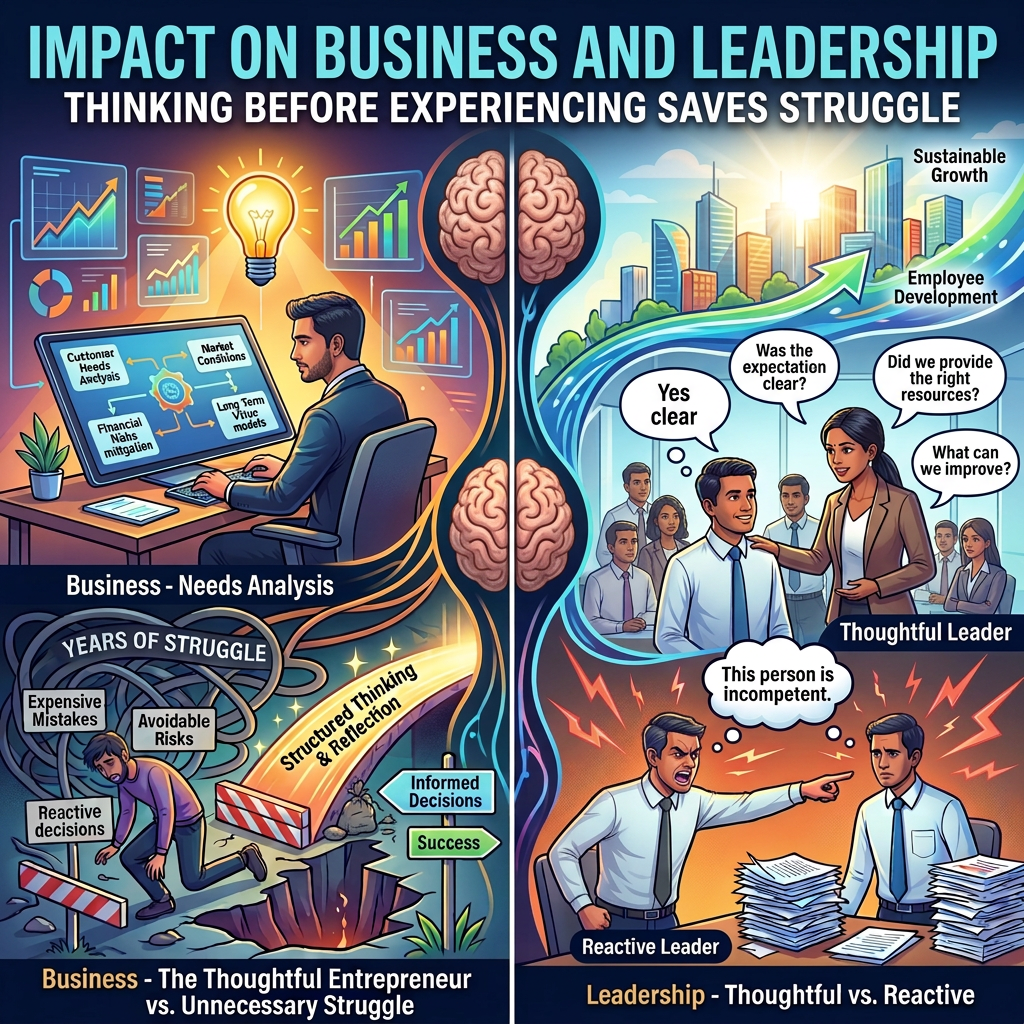
In business, thinking before experiencing can save years of unnecessary struggle.
An entrepreneur who thinks carefully about customer needs, market conditions, financial risks, and long-term value is better prepared to make informed decisions. Instead of learning every lesson through expensive mistakes, the entrepreneur uses research, reflection, and structured thinking to reduce avoidable risks.
For a leader, the difference is equally important. When an employee makes a mistake, a reactive leader thinks, “This person is incompetent.” A thoughtful leader asks, “Was the expectation clear? Did we provide the right resources? What can we improve?”
The second approach creates psychological safety, accountability, and continuous improvement.
Great leadership is not merely about managing experiences; it is about shaping the thinking that creates better experiences.
5. Why This Matters to Doctors and Clinical Practice

Clinical practice provides an excellent example of this philosophy.
A doctor approaching a complicated patient with preconceived assumptions may overlook important information. A doctor who begins with structured clinical reasoning, considers alternative diagnoses, evaluates evidence, and remains open to uncertainty is more likely to make a sound clinical decision.
The experience of treating the patient then becomes an opportunity to validate or revise the initial clinical thinking.
The feeling that follows may include professional satisfaction, concern, or uncertainty. However, those feelings should be acknowledged without replacing objective clinical judgment.
For doctors, the sequence becomes:
Think critically → Examine and experience clinically → Reflect emotionally and intellectually → Improve future decisions.
This approach supports patient safety, evidence-based medicine, and lifelong learning.
6. Lessons from Successful Indian and International Leaders
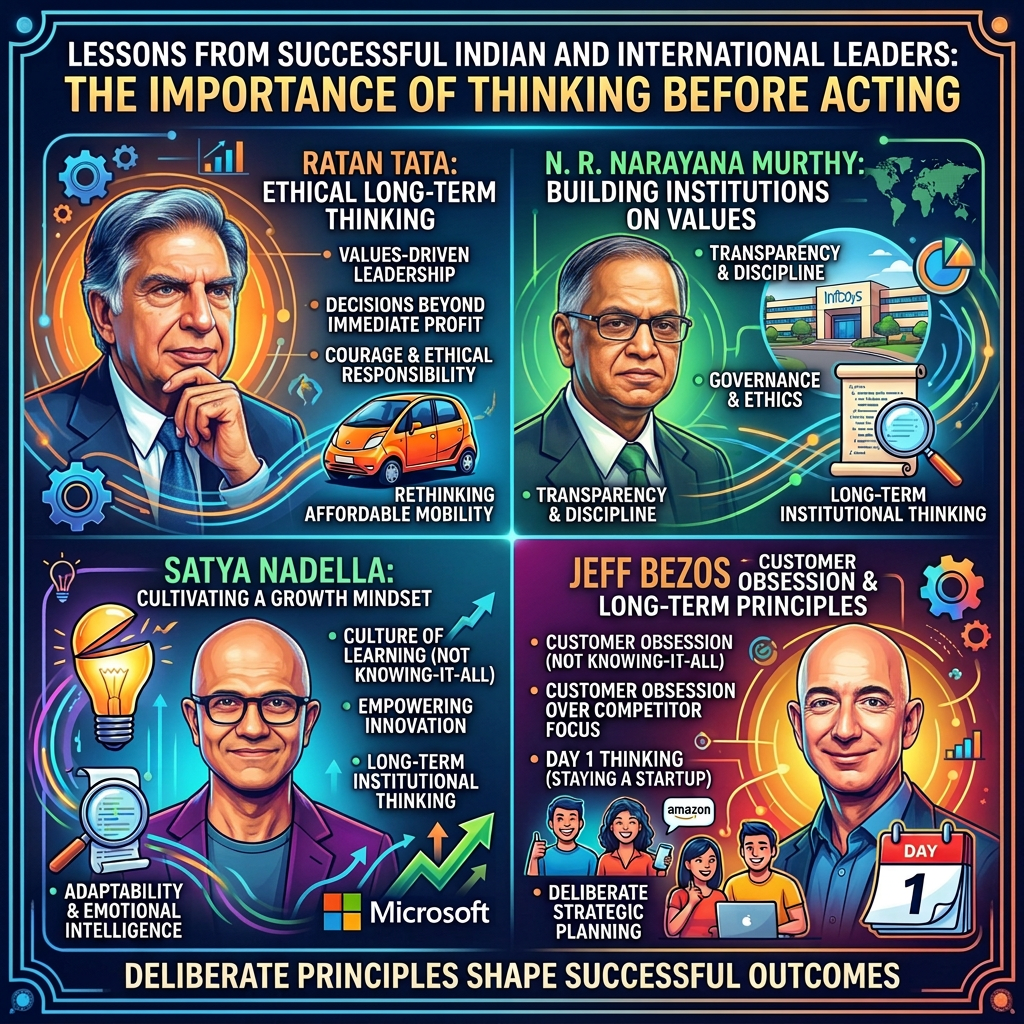
Several successful leaders demonstrate the importance of thinking before acting.
- Ratan Tata: His leadership at Tata Group reflected long-term thinking, ethical responsibility, and the courage to make decisions beyond immediate commercial benefits. The Nano project, regardless of its eventual commercial outcome, demonstrated an attempt to rethink affordable mobility.
- N. R. Narayana Murthy: His approach to building Infosys highlighted the importance of values, transparency, discipline, and long-term institutional thinking.
- Satya Nadella: At Microsoft, he encouraged a growth mindset and a culture of learning rather than assuming that past success guaranteed future success.
- Jeff Bezos: His emphasis on customer obsession and long-term thinking illustrates how deliberate principles can shape business decisions and customer experiences.
Their journeys remind us that success is rarely just about accumulating experiences. It is also about developing the right thinking to interpret those experiences and make better decisions.
7. How to Develop the
Thinking → Experience → Feeling Framework

Here is a practical seven-step action plan:
- Pause before reacting: Do not allow the first thought to become your final decision.
- Question your assumptions: Ask yourself whether your interpretation is based on facts or fear.
- Visualise possible outcomes: Consider the best, worst, and most realistic scenarios.
- Prepare before acting: Gather information, identify risks, and define your purpose.
- Experience consciously: Pay attention to what is actually happening rather than what you expected to happen.
- Examine your feelings: Ask why you feel satisfied, disappointed, anxious, or confident.
- Reflect and refine: Convert the experience into improved thinking for your next decision.
Practise this every day, whether you are making a personal decision, attending a professional meeting, treating a patient, or leading an organisation.
8. How Understanding This Thesis Early Compounds Your Life
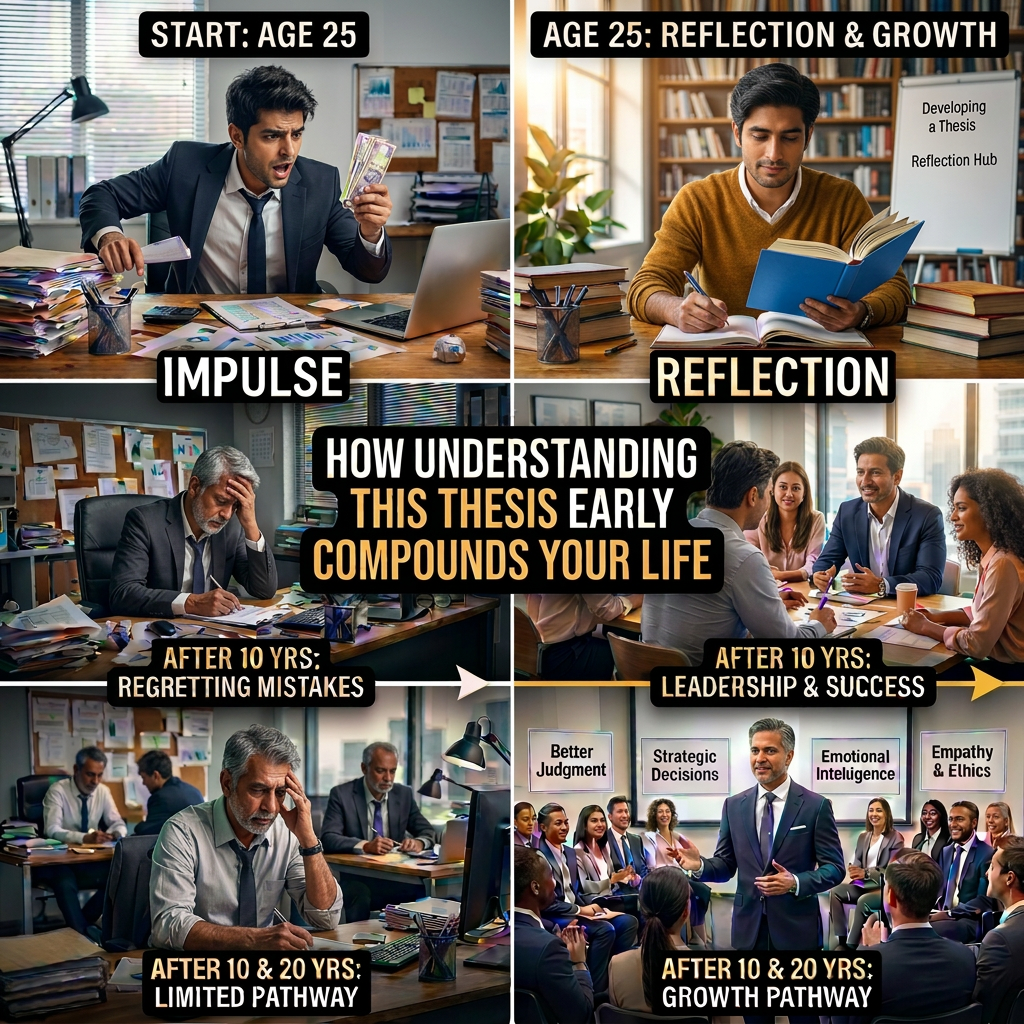
Imagine two individuals beginning their careers at the age of 25. One makes decisions primarily through impulse and learns only after facing consequences. The other develops the habit of thinking, evaluating, experiencing, and reflecting.
After ten or twenty years, the difference can be substantial.
The second individual gradually develops better judgment, emotional awareness, decision-making ability, and leadership maturity. These improvements influence everyday relationships, professional responsibilities, entrepreneurial decisions, and even the quality of clinical practice.
Like compound interest, better thinking compounds through repeated daily decisions.
The earlier we understand this principle, the more opportunities we have to apply it. We become less reactive, more intentional, and better prepared to navigate uncertainty.
Conclusion: Change Your Thinking Before You Change Your Experience
Experience is undoubtedly valuable, but we do not have to wait for every difficult experience to teach us how to live, lead, or succeed.
The real opportunity lies in developing the habit of thinking consciously before experiencing a situation and understanding our feelings afterwards.
Thinking → Experience → Feeling is more than a sequence of words. It is a practical philosophy for personal development, professional excellence, responsible leadership, entrepreneurship, and better clinical practice.
Start applying it today. Your next experience may be the same as yesterday’s, but your thinking can make tomorrow’s response entirely different.
If this article gave you a new perspective, please share your thoughts in the comment section below. Also, share this article with at least one individual who needs to understand this powerful principle.
If you haven’t subscribed yet, please subscribe through the Email Subscription Box at the bottom of this page to receive more such thought-provoking articles.
Because a better life does not always begin with a better experience. Sometimes, it begins with better thinking.
Stay tuned!!
Image Disclaimer: Images used in this article are provided for illustrative, educational, and informational purposes only. Any company names, brand names, logos, trademarks, products, services, or other identifiable brand elements appearing in an image are the property of their respective owners. Their inclusion does not imply any endorsement, sponsorship, partnership, affiliation, or association with the author, publisher, or this website. The images are images are intended solely to help explain or visualize the concepts discussed in the article.


Leave a Reply