Design your inner-self, build your dream business!!

Attitude Is Greater Than Experience, and Experience Is Greater Than Education: The Life and Business Lessons We Must Understand Early

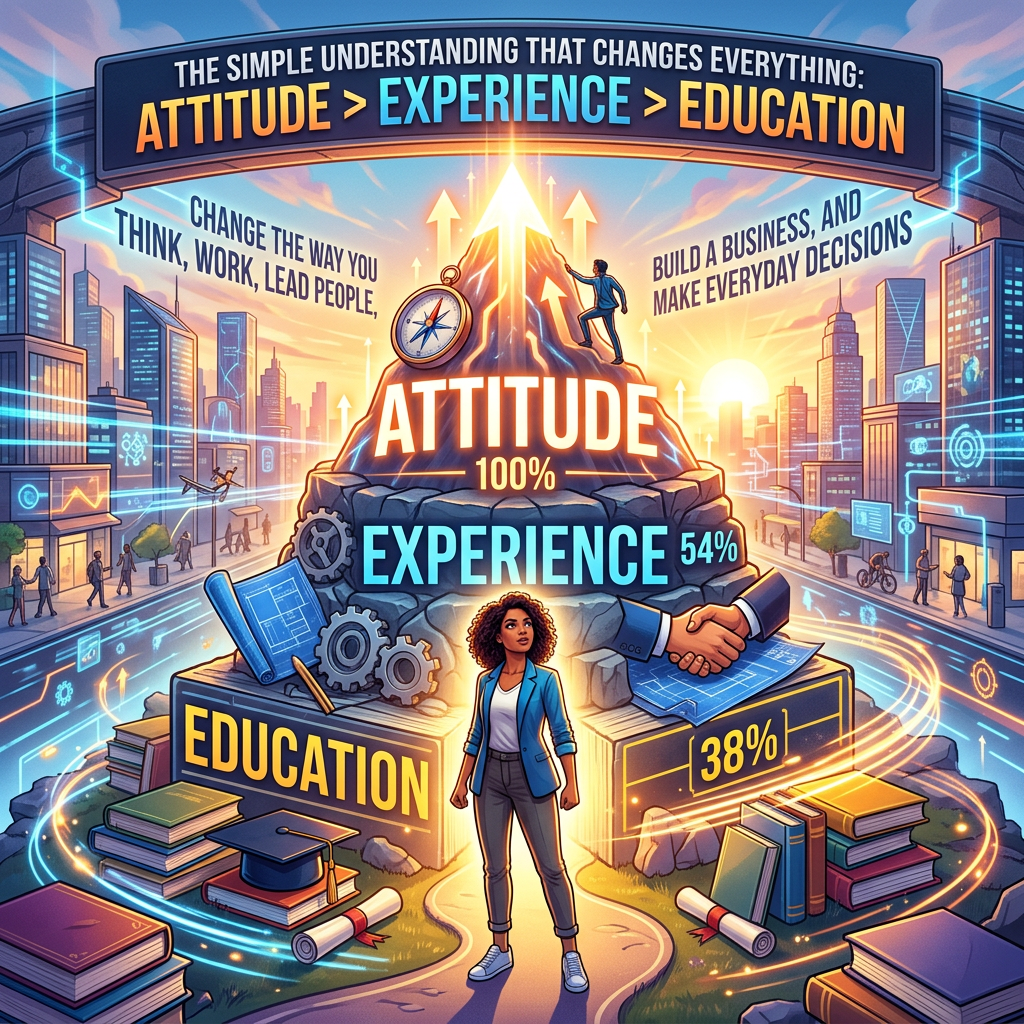
Illustration reading “Attitude 100%, Experience 54%, Education 38%” with growth arrows

Personal Growth | Leadership | Entrepreneurship | Professional Excellence| Doctor’s Clinical Life

What if one simple understanding, discovered early in life, could change the way you think, work, lead people, build a business and make everyday decisions?

Here is a powerful principle:

Attitude > Experience > Education

Education gives us knowledge. Experience teaches us how to apply that knowledge. But attitude determines whether we are willing to learn, adapt, take responsibility and move forward.

This is not an argument against education. It is a reminder that knowledge alone cannot guarantee success.

Let’s understand why.

1. What Is Attitude, and Why Does It Matter?
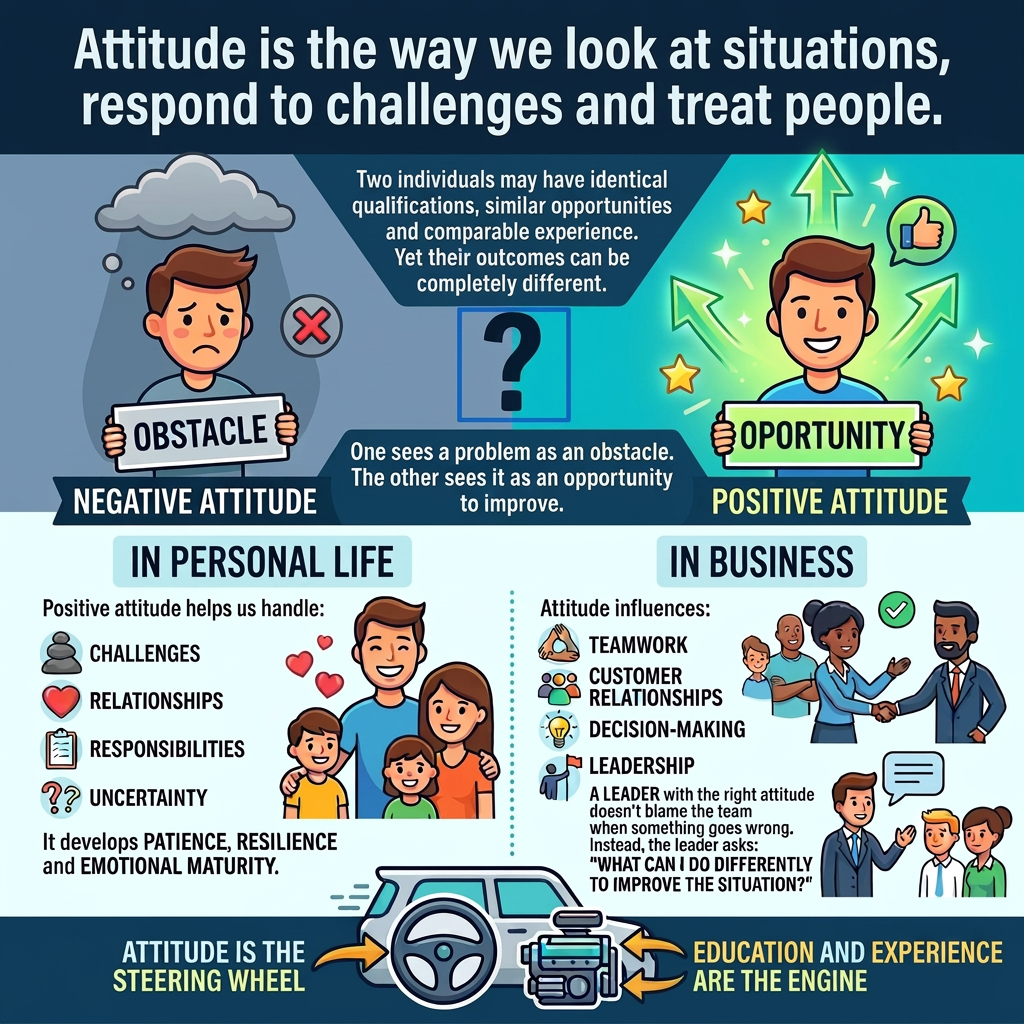
Infographic titled “What Is Attitude, and Why Does It Matter?” comparing negative and positive attitudes, personal life, business, and attitude as the steering wheel of knowledge and experience.

Attitude is the steering wheel; education and experience are the engine.

2. Why Is Attitude Greater Than Experience?
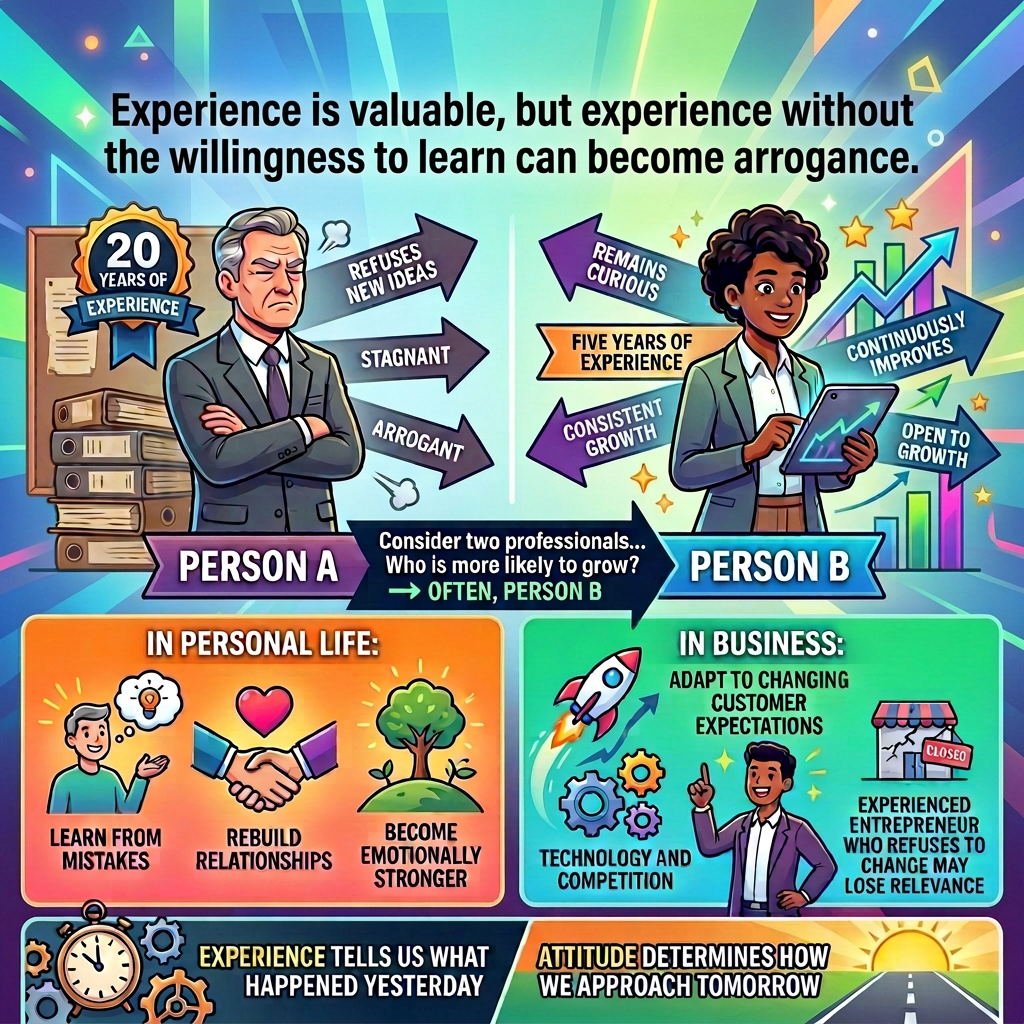
Infographic comparing stagnant experience with curious, growth-oriented attitude

Experience tells us what happened yesterday. Attitude determines how we approach tomorrow.

3. Why Is Experience Greater Than Education?
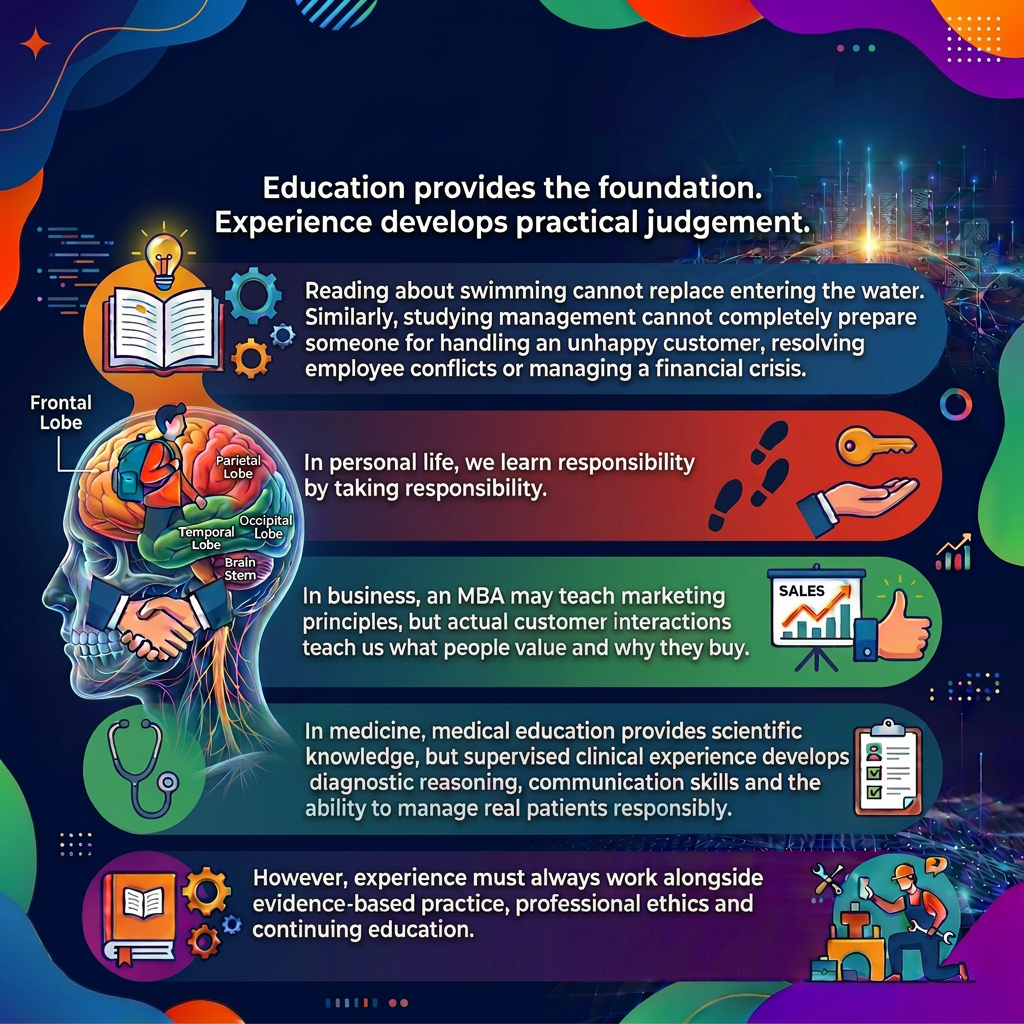
Infographic titled "WHY IS EXPERIENCE GREATER THAN EDUCATION?" with the subtitle "Education provides the foundation. Experience develops practical judgement." It states: "Reading about swimming cannot replace entering the water. Similarly, studying management cannot completely prepare someone for handling an unhappy customer, resolving employee conflicts or managing a financial crisis." "In personal life, we learn responsibility by taking responsibility." "In business, an MBA may teach marketing principles, but actual customer interactions teach us what people value and why they buy." "In medicine, medical education provides scientific knowledge, but supervised clinical experience develops diagnostic reasoning, communication skills and the ability to manage real patients responsibly." It concludes: "However, experience must always work alongside evidence-based practice, professional ethics and continuing education. Education teaches the principles; experience develops the judgement to apply them."

The important lesson is simple: Education teaches the principles; experience develops the judgement to apply them.

4. The Five Pillars of a Meaningful and Successful Life

The relationship between attitude, experience and education becomes clearer when we examine five important areas.
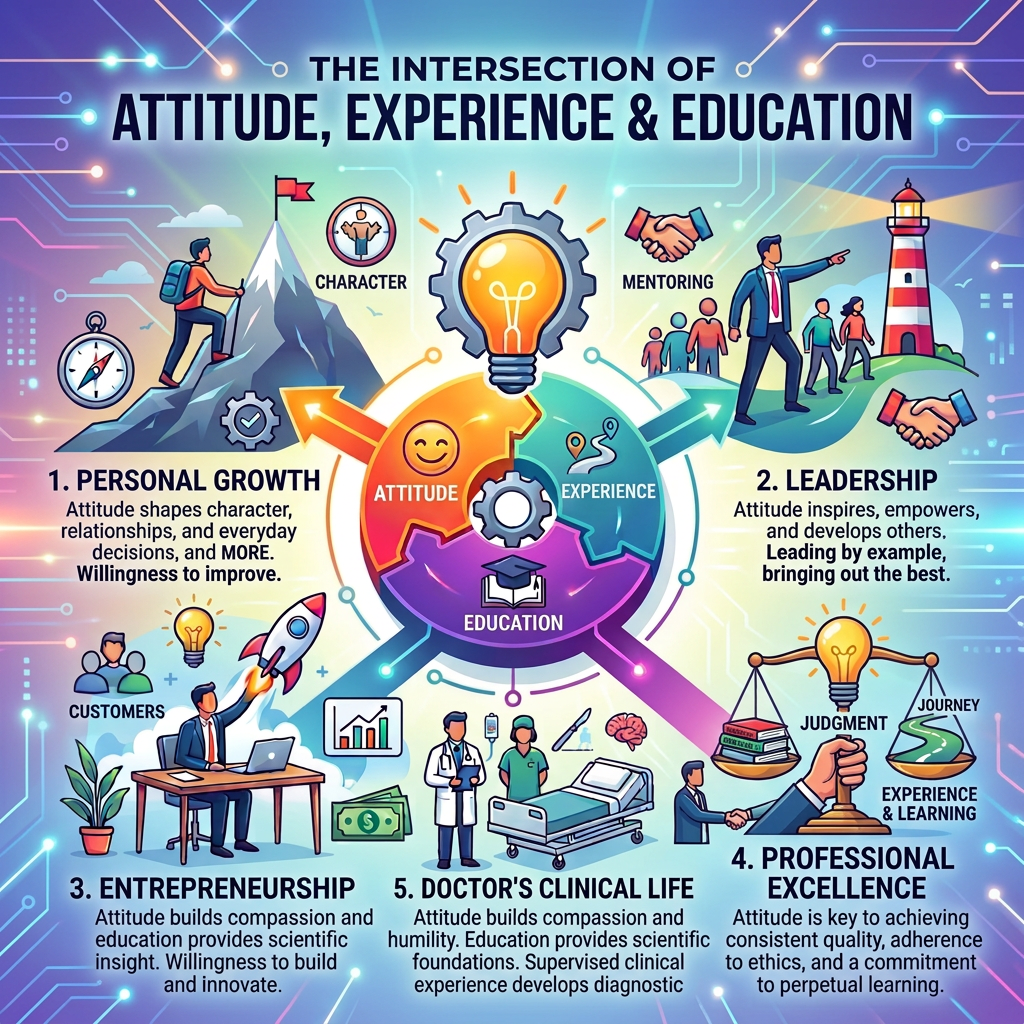
Infographic titled “The Intersection of Attitude, Experience & Education” with five application areas.

These five pillars may look different, but they share one foundation: the willingness to learn and improve every day.

5. Why This Principle Is Particularly Important in a Doctor’s Clinical Life

A medical degree makes someone academically qualified to practise within their competence. However, becoming a good clinician requires much more than academic achievement.

It requires the right attitude towards patients, respect for colleagues, willingness to learn from senior doctors, openness to new scientific evidence and the humility to recognise one’s limitations.
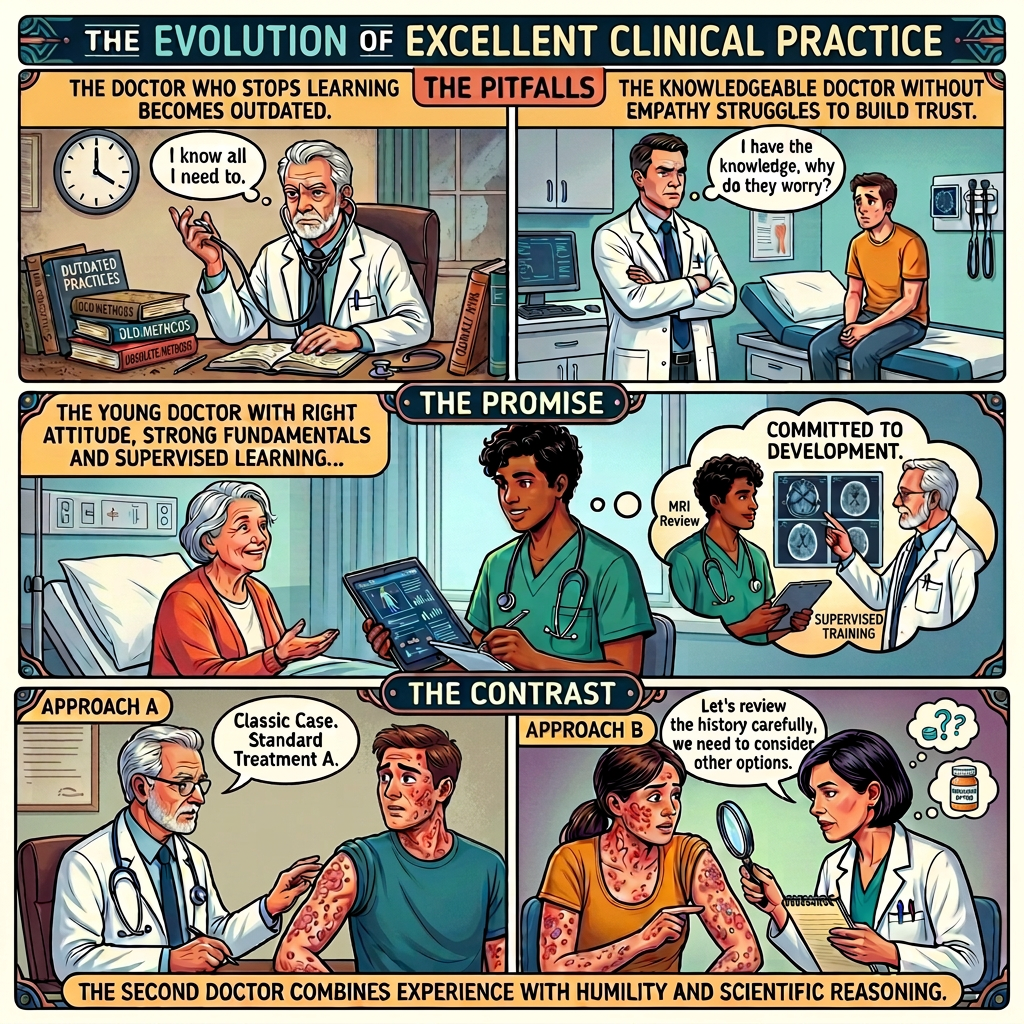
Clinical practice comic contrasting outdated doctors with humble, evidence-informed care

In medicine, attitude without knowledge is unsafe, knowledge without experience is incomplete, and experience without continuous learning can become dangerous.

This is why clinical excellence requires all three, working together.

6. Understanding the Thesis Early: The Power of Compounding

This is perhaps the most important lesson.

When we understand early in life that attitude drives learning, experience strengthens judgement and education provides the foundation, our daily decisions begin to change.

Think of it as compound interest.

A small improvement in attitude every day creates better decisions. Better decisions create valuable experiences. Valuable experiences improve professional judgement. Over several years, these small improvements can produce extraordinary results.
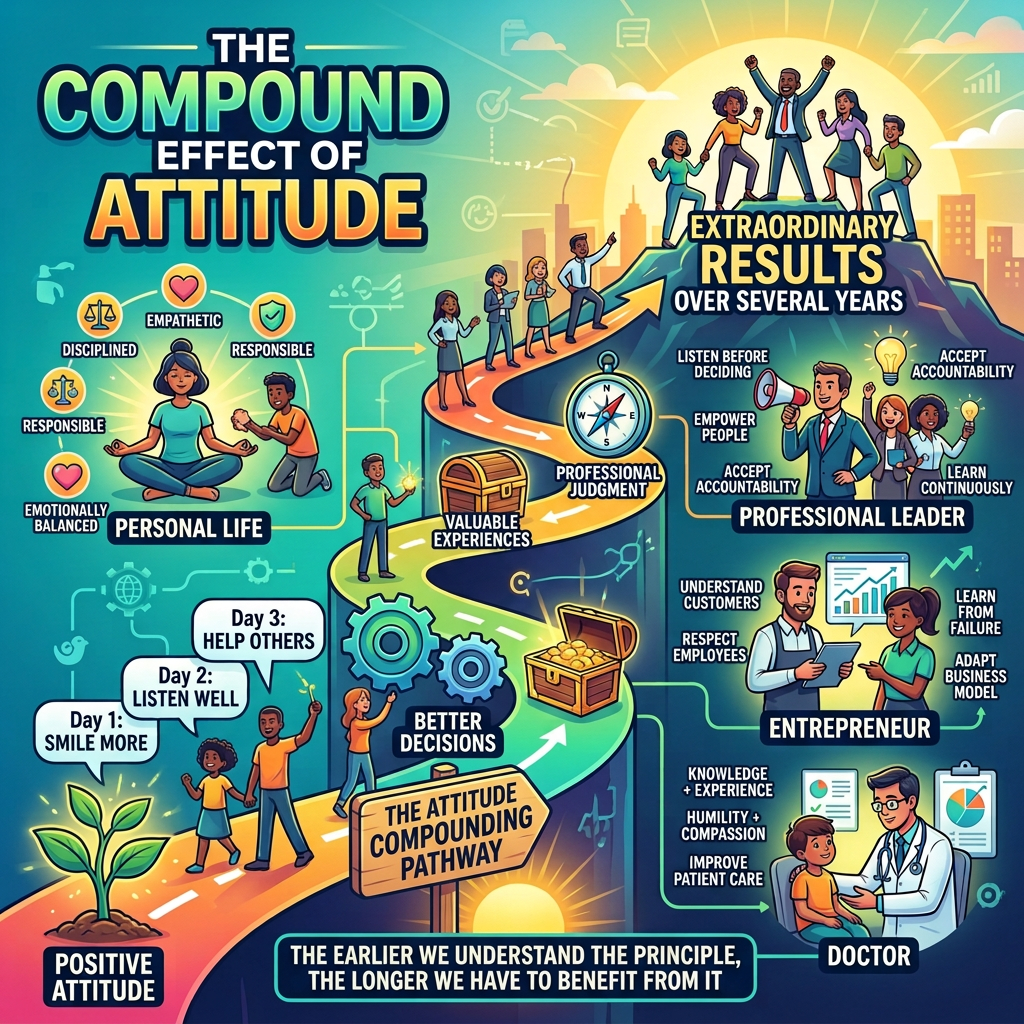
Infographic titled “The Compound Effect of Attitude,” showing positive habits leading to extraordinary results over several years.

The earlier we understand the principle, the longer we have to benefit from it.

7. Lessons from Successful Indian and International Leaders

Several successful leaders demonstrate these principles through their journeys.
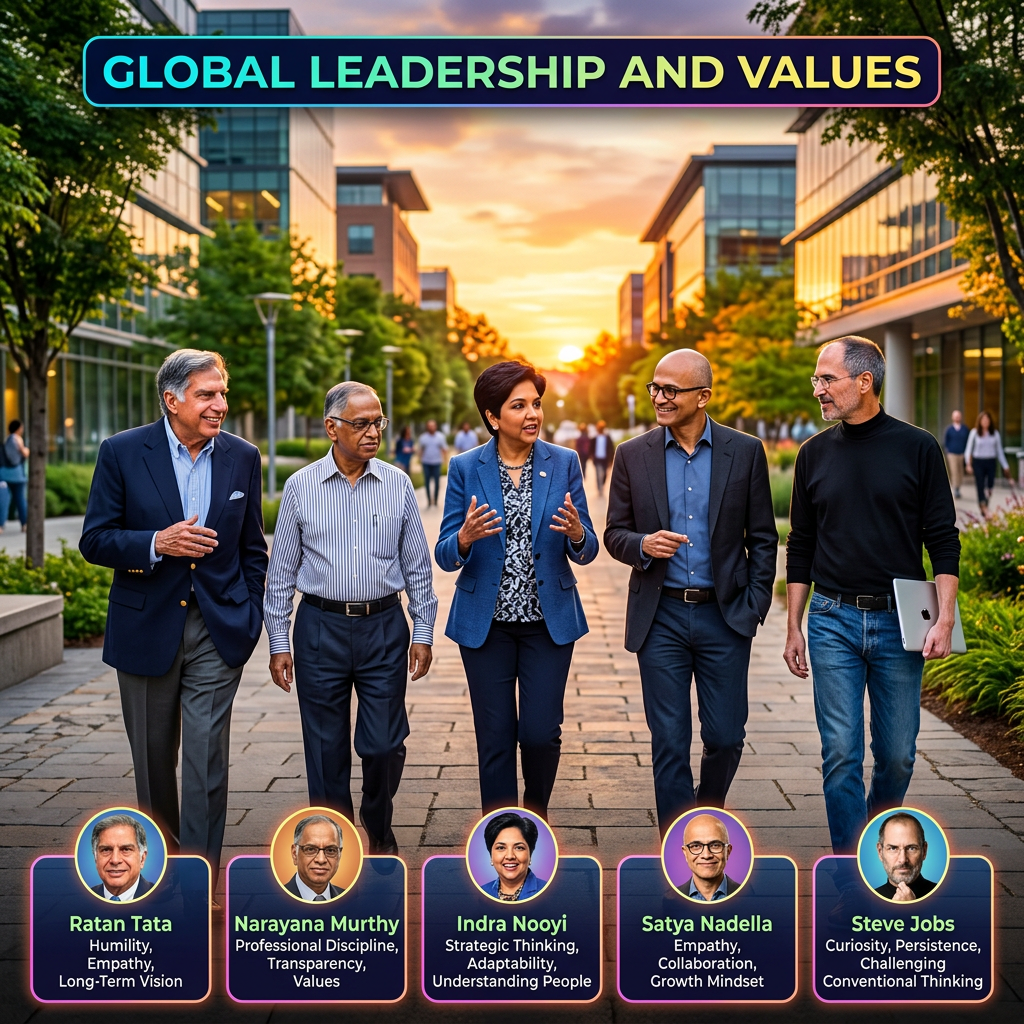
Text reads “GLOBAL LEADERSHIP AND VALUES”; five leaders labeled Ratan Tata, Narayana Murthy, Indra Nooyi, Satya Nadella, and Steve Jobs, with values listed below each name.

Their journeys were different, but a common thread connects them: the willingness to learn, adapt and lead with conviction.

8. A Practical Seven-Step Action Plan

Understanding a principle is useful only when we practise it.
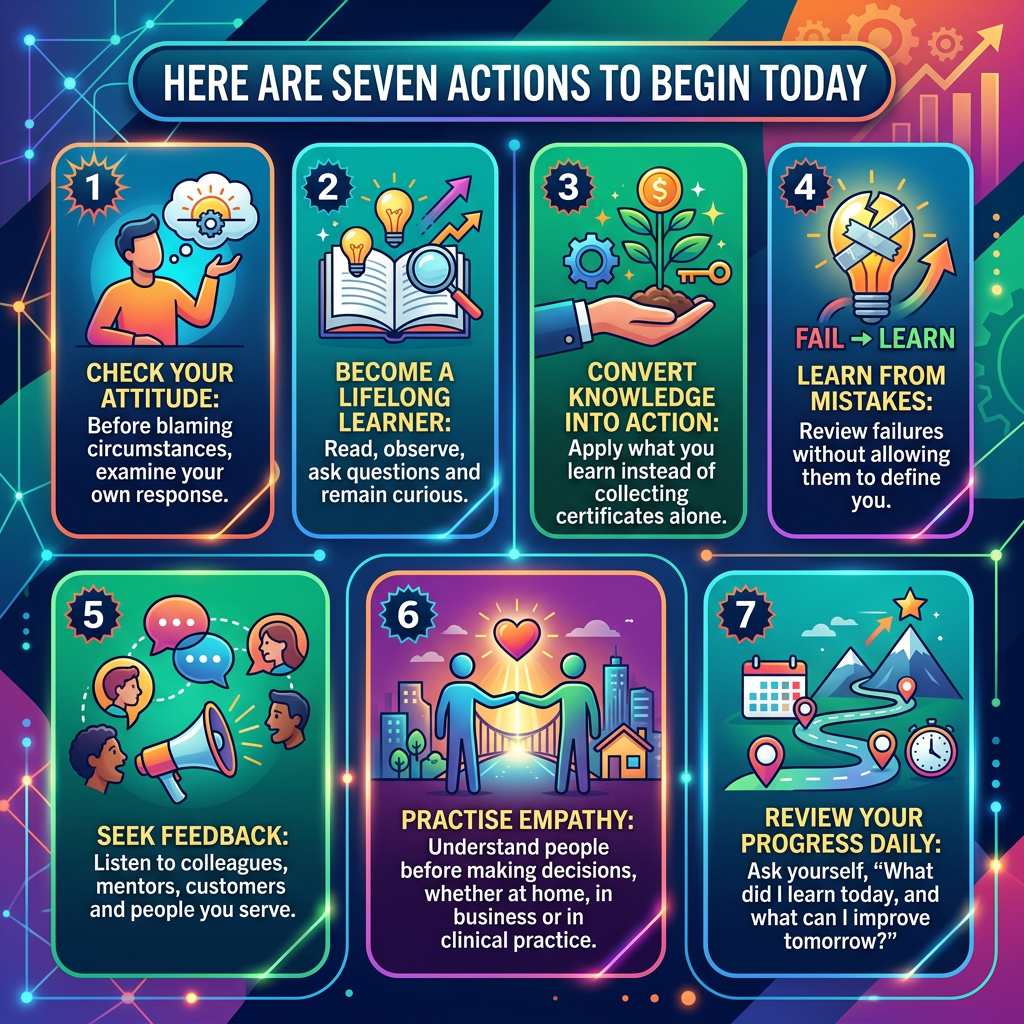
Infographic titled "HERE ARE SEVEN ACTIONS TO BEGIN TODAY" with seven numbered actions: 1, "CHECK YOUR ATTITUDE: Before blaming circumstances, examine your own response." 2, "BECOME A LIFELONG LEARNER: Read, observe, ask questions and remain curious." 3, "CONVERT KNOWLEDGE INTO ACTION: Apply what you learn instead of collecting certificates alone." 4, "LEARN FROM MISTAKES: Review failures without allowing them to define you." 5, "SEEK FEEDBACK: Listen to colleagues, mentors, customers and people you serve." 6, "PRACTISE EMPATHY: Understand people before making decisions, whether at home, in business or in clinical practice." 7, "REVIEW YOUR PROGRESS DAILY: Ask yourself, What did I learn today, and what can I improve tomorrow?"

Small actions, consistently repeated, create remarkable long-term results.

9. Conclusion: Understand the Thesis Before Time Teaches It to You

Life is not simply about collecting degrees, accumulating years of experience or achieving professional titles.

It is about developing the right attitude, learning from experience and applying education with wisdom.

Whether you are a student, parent, employee, entrepreneur, business leader or doctor, this principle remains relevant.

Never allow experience to make you arrogant. Never allow education to make you complacent. And never allow circumstances to destroy your attitude.

Remember:

Your education may open the door. Your experience may help you navigate the room. But your attitude determines how far you are willing to go.

The earlier you understand this thesis, the more effectively you can compound its benefits throughout your personal and professional life.

A Small Request to Every Reader

If this article made you reflect on your own journey, please:

  • Share your thoughts: What has contributed more to your success—attitude, experience or education? Please comment below.
  • Share this article: Send it to at least one individual who needs to understand this principle early in life or career.
  • Subscribe: If you haven’t subscribed yet, please enter your email address in the Subscription Box at the bottom of this page to receive future articles and insights.

Sometimes, one idea understood at the right time can change the direction of an entire life.

Leave a Reply

  • Fundamentals vs Fame in Life and Business: Why the Quiet Path Wins Every Time!

    Fundamentals vs Fame in Life and Business: Why the Quiet Path Wins Every Time!

    A conversation with a startup founder revealed the tension between fame and fundamentals. While fame attracts attention, it often lacks substance; true success relies on strong foundations. Businesses prioritize fundamentals—like skill development and ethical practices—over fleeting visibility. The article emphasizes that long-term value truly nurtures growth and resilience in careers and ventures.

  • Generalist vs Specialist: Why T-Shaped Leadership Matters in Life and Business

    Generalist vs Specialist: Why T-Shaped Leadership Matters in Life and Business

    The content discusses the dilemma between being a generalist or specialist in one’s career, emphasizing that success isn’t about choosing one path but knowing when each is applicable. T-shaped leadership, combining deep expertise with broad knowledge, is showcased as the ideal approach, enabling leaders to adapt, collaborate, and remain relevant across industries.

  • 1st Generation vs 3rd Generation Business Owners: How Understanding Their Mindset Can Transform Your Life and Business!

    1st Generation vs 3rd Generation Business Owners: How Understanding Their Mindset Can Transform Your Life and Business!

    The article contrasts the mindsets of 1st generation and 3rd generation business owners, highlighting how their experiences shape decision-making. While 1st generation owners emphasize immediate risks and survival, 3rd generation owners focus on long-term strategies and stability. Recognizing these differences can enhance communication, mitigate conflicts, and foster personal growth in business environments.

  • Dopamine Is Not the Pursuit of Happiness—Happiness Is the Pursuit: A Neuroscience-Based Guide for Life and Business

    Dopamine Is Not the Pursuit of Happiness—Happiness Is the Pursuit: A Neuroscience-Based Guide for Life and Business

    Andrew Huberman argues that dopamine, essential for motivation, should be linked to effort rather than instant gratification. High dopamine spikes lead to crashes, resulting in emotional flatness. Sustainable happiness stems from consistent effort, as seen in practices like exercise and skill-learning. True fulfillment arises from stabilizing dopamine levels, not chasing fleeting highs.

  • Possibility vs Probability: The Attitude That Shapes Life and Business

    Possibility vs Probability: The Attitude That Shapes Life and Business

    The distinction between probability and possibility thinking shapes personal and professional decisions. Probability focuses on historical data and risk assessment, often stifling growth. In contrast, possibility emphasizes potential and adaptability, fostering innovation and leadership. Embracing possibility encourages bold actions and consistent efforts, leading individuals to turn challenges into opportunities for success.

Subscribe

Enter your email below to receive updates.