

“A river reaches the ocean not because it is the strongest, but because it knows when to change its course without changing its destination.”
Have you ever agreed to something just to avoid conflict, only to regret it later? Or changed your approach to solve a problem and felt stronger because of it?
These two situations may seem similar, but they are very different.
One is adjustment. The other is compromise.
Understanding this difference early in life is one of the greatest advantages you can have—not only in relationships but also in leadership, career, and business.
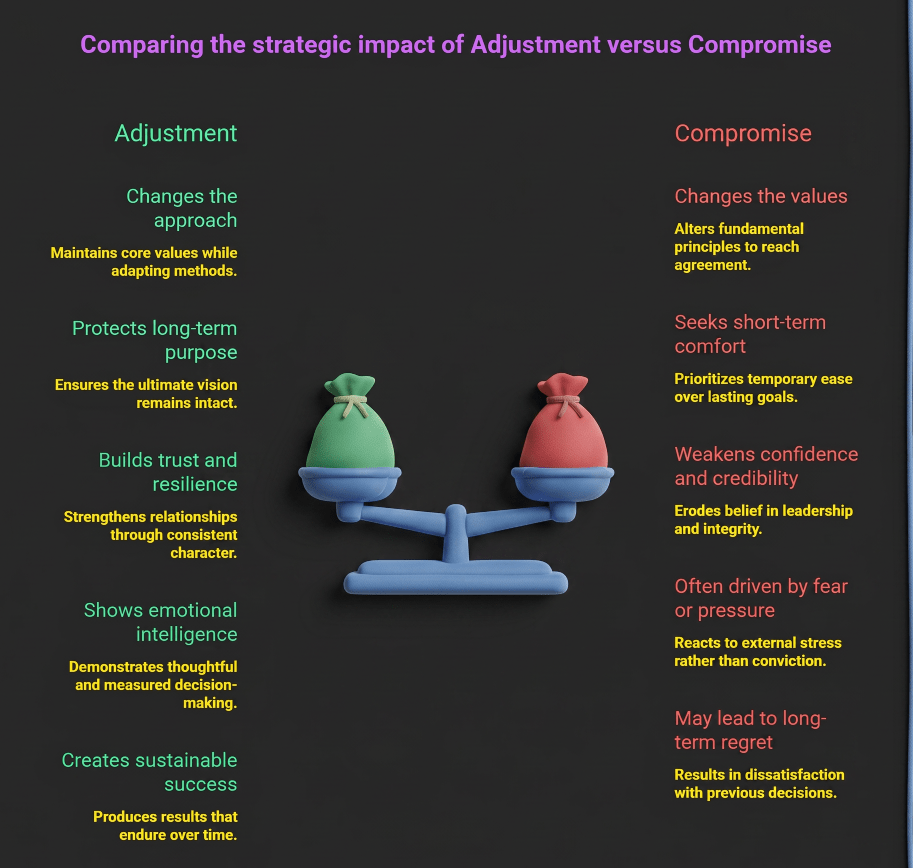
Adjustment vs. Compromise: Where Is the Difference?
Adjustment means changing your approach while protecting your values.
Compromise means giving up your values for short-term comfort, acceptance, or gain.
Imagine you’re driving to an important meeting and the main road is closed. You take another route and still reach your destination. That’s adjustment.
Now imagine cancelling the meeting altogether because taking a different route feels inconvenient. That’s compromise.
Here’s a question for you: When was the last time you changed your approach without changing your principles?
Why Adjustment Is a Sign of Emotional Intelligence
Emotionally intelligent people don’t react—they respond.
Suppose a manager receives harsh feedback from a client. An emotional reaction might be to argue or blame the team. An emotionally intelligent response is to listen, learn, adjust the process, and improve the outcome without compromising quality or integrity.
The same applies at home. If your child isn’t responding to one way of teaching, you change the method—not your commitment to helping them learn.
Adjustment is flexibility with purpose.
Compromise is flexibility without direction.
How Adjustment Creates Better Results in Life and Business
Early in my career, I believed changing my plans meant admitting failure. Over time, I realised something important: successful people rarely stick rigidly to a plan—they stay committed to the goal. They adjust their strategy when circumstances change, but they don’t abandon what truly matters.
Entrepreneurs do this every day. During the pandemic, many local restaurants shifted from dine-in services to online deliveries. They adjusted how they served customers but didn’t compromise on food quality or customer experience. Those that adapted thoughtfully often emerged stronger.
Now ask yourself:
Are you protecting your purpose, or just protecting your comfort?
The Hidden Cost of Compromise
Compromise often looks harmless in the beginning.
A business owner reduces product quality to save costs.
A professional stays silent about unethical behaviour to protect a promotion.
A student copies an assignment because it’s easier than learning.
These choices may solve today’s problem, but they create tomorrow’s regret.
Trust, once compromised, is difficult to rebuild.
Character grows through adjustment—not compromise.
Leaders Who Adjusted Without Compromising
Great leaders understand this balance.
- Ratan Tata adapted the Tata Group to changing global markets while preserving its reputation for ethics and trust.
- N. R. Narayana Murthy built Infosys by embracing global opportunities without compromising transparency and integrity.
- Satya Nadella transformed Microsoft’s culture by replacing internal competition with collaboration while remaining committed to innovation.
- Indra Nooyi reshaped PepsiCo’s product strategy by investing in healthier choices without losing sight of long-term business growth.
Their success came from changing strategies—not changing principles.
Your 5-Step Action Plan: Adjust Without Compromising
This week, try these simple steps:
1. Define your non-negotiables.
Write down the three values you will never compromise—perhaps integrity, family, health, or honesty. If a decision asks you to sacrifice one of these, pause before saying yes.
2. Separate the goal from the method.
Remember: your destination can stay the same even if your route changes.
3. Ask one powerful question before every major decision.
“Am I adjusting my approach, or am I compromising my values?”
4. Reflect every evening.
Think about one situation where you adapted well and one where you may have compromised unnecessarily. Awareness is the first step to change.
5. Start small.
Over the next 7 days, consciously make one adjustment each day without compromising your principles. At the end of the week, notice how your confidence and decision-making improve.
Final Thoughts
Life doesn’t reward those who refuse to change. It rewards those who know what to change and what to protect.
Adjust your methods. Improve your skills. Learn from feedback. Embrace change.
But never compromise your integrity, your purpose, or the values that define who you are.
Now, over to you: Have you ever adjusted your approach and achieved a better outcome? Or have you experienced the cost of compromising your values? Share your story in the comments below—your experience might encourage someone facing a similar challenge today.
If this article added value to your perspective, please share it with at least one person who could benefit from this message.
And if you haven’t already, subscribe through the email Subscription Box at the bottom of this page to receive more practical insights on leadership, entrepreneurship, and purposeful living.
Stay tuned!!







 Wining Life & Business
Leave a comment