

Have you ever been absolutely certain about something, only to discover later that you were wrong?
Most of us have.
Maybe you believed you were not good at public speaking until you delivered a successful presentation. Maybe you thought a business idea would fail, only to see someone else turn it into a thriving company. These experiences reveal an important truth:
Beliefs are tools we use to interpret reality. They are not reality itself.
Understanding this distinction can dramatically improve how we make decisions, lead teams, build businesses, and navigate everyday life.
Why This Topic Matters More Than Ever
Take a moment and reflect on these questions:
- What belief about yourself has influenced your career the most?
- Are there opportunities you’ve avoided because of assumptions you hold?
- What if one of your strongest beliefs isn’t actually true?
Many people spend years operating from inherited beliefs—ideas picked up from family, society, education, or past experiences. Some of these beliefs are empowering. Others quietly limit our potential.
The ability to question and update beliefs is becoming one of the most valuable skills in a rapidly changing world.
Key Takeaway: A belief should help you navigate life. The moment it stops helping, it deserves examination.
What Does “Belief Is a Tool, Not the Truth” Actually Mean?
A belief is an interpretation. Truth is what exists regardless of our interpretation.
Think of a pair of glasses. The glasses help you see, but they also influence how you see. Beliefs work the same way.
A Simple Everyday Example
A young professional once believed that leadership was only for extroverts. As a result, she avoided management opportunities despite consistently delivering excellent results.
Years later, after observing successful quiet leaders and receiving encouragement from mentors, she realized her belief was simply an assumption—not a fact.
Once she changed that belief, her career trajectory changed as well.
The truth had never changed. Only her interpretation had.
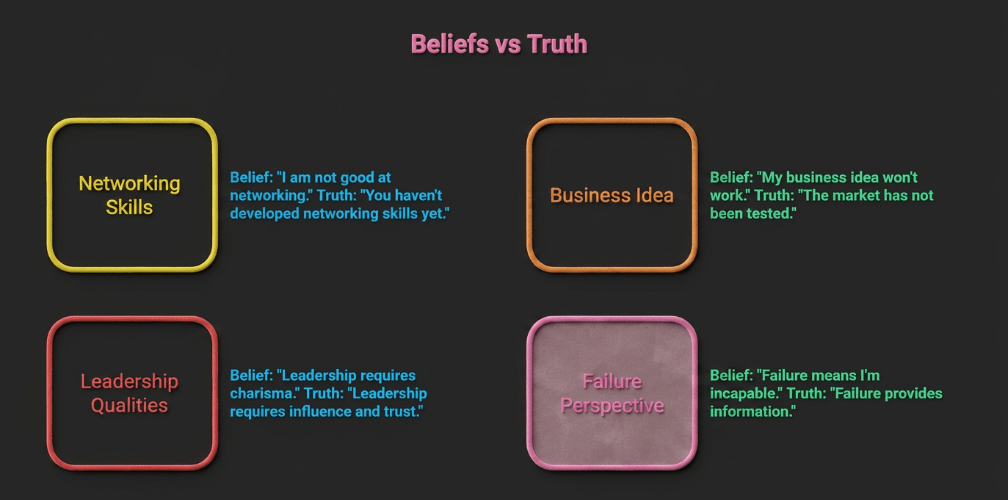
The difference seems small, but it can change the direction of an entire life.
Key Takeaway: When you separate facts from assumptions, you create room for growth and possibility.
How Beliefs Shape Everyday Life
Our beliefs influence decisions long before we realize they are doing so.
A few years ago, a friend wanted to start a consulting practice. Every conversation ended with a reason why it would not work:
- The market is saturated.
- I don’t have enough experience.
- Nobody will hire me.
After months of discussion, one simple question emerged:
“How many potential clients have you actually spoken to?”
The answer was zero.
The belief had become stronger than reality.
After speaking with a handful of potential customers, he discovered there was genuine demand. Within a year, he had paying clients and a growing business.
The situation never changed. His willingness to test the belief did.
Many people remain stuck not because reality blocks them, but because untested beliefs do.
Key Takeaway: Most limitations begin as stories. Testing them often reveals opportunities hidden in plain sight.
Why Learning This Lesson Early Creates a Lifetime Advantage
The earlier we understand the difference between belief and truth, the more powerful the impact becomes.
Just as money compounds through investment, decisions compound through mindset.
The Compounding Effect
Imagine two individuals beginning their careers.
Person A believes:
“I need to avoid mistakes.”
Person B believes:
“Mistakes are part of learning.”
After ten years, Person B has likely taken more risks, learned more skills, built more relationships, and accumulated more experience.
The difference isn’t intelligence.
It’s the belief system guiding decisions.
I often think of learning to ride a bicycle. Nobody masters cycling by believing they can never fall. Progress happens because they understand falling is feedback, not failure.
The same principle applies to careers, businesses, and leadership.
Key Takeaway: Small belief shifts today can produce dramatically different results over the next decade.
The Leadership Advantage: Separating Assumptions from Reality
Leadership is often less about having answers and more about asking better questions.
Strong leaders consistently challenge their own thinking.
Instead of saying:
“We know this will work.”
They ask:
- What evidence supports this?
- What assumptions are we making?
- What are we missing?
A Personal Leadership Observation
Many first-time managers believe they must have all the answers to earn respect.
This belief often creates stress and poor decision-making.
The best leaders I’ve encountered admit when they don’t know something. They seek input, gather information, and make informed decisions.
Their confidence comes from learning—not pretending.
That’s the difference between leading through truth and leading through ego.
Key Takeaway: Great leaders are willing to update their beliefs when new information appears.
How Entrepreneurs Win by Treating Beliefs as Hypotheses
Entrepreneurship is essentially a continuous experiment.
Every business idea begins as a belief.
- Customers will buy this.
- This problem matters.
- This solution adds value.
The market then determines whether those beliefs are accurate.
The Entrepreneur’s Mindset
Successful founders don’t become emotionally attached to assumptions.
Instead, they ask:
“What is the market teaching me?”
Businesses often fail when owners fall in love with their beliefs instead of listening to reality.
Businesses grow when founders remain curious and adaptable.
The ability to revise assumptions quickly is often more valuable than having the perfect plan from the beginning.
Key Takeaway: Entrepreneurs succeed by testing beliefs, not defending them.
Lessons from Successful Indian Business Leaders
Ratan Tata: Humility Creates Better Decisions
Ratan Tata’s leadership demonstrated the importance of listening, learning, and adapting.
Throughout his career, he consistently balanced conviction with openness to new information. Whether expanding globally or launching innovative products, decisions were rooted in understanding changing realities rather than clinging to outdated assumptions.
His example reminds us that strong leadership is not stubbornness.
It is thoughtful adaptability.
Leadership Lesson
Hold your vision firmly, but hold your assumptions lightly.
N. R. Narayana Murthy: Challenging Limiting Beliefs
When Infosys was founded, many believed India could not become a global technology powerhouse.
Narayana Murthy and his team chose not to accept that belief as truth.
Instead, they focused on execution, transparency, and long-term value creation.
Their success helped reshape global perceptions of India’s technology sector.
Leadership Lesson
Many breakthroughs begin when someone questions a widely accepted belief.
Dhirubhai Ambani: Seeing Opportunity Where Others Saw Obstacles
Dhirubhai Ambani became known for identifying possibilities that others overlooked.
While many focused on constraints, he focused on opportunities.
His success came not from ignoring reality but from refusing to accept conventional assumptions without questioning them.
Leadership Lesson
Opportunities often exist beyond the boundaries of common belief.
Key Takeaway from All Three Leaders: Extraordinary success often begins with the courage to challenge assumptions while remaining grounded in reality.
A Practical Action Plan for Readers
Step 1: Identify One Limiting Belief
Write down one belief that may be holding you back.
Example:
“I am not capable of leading a team.”
Step 2: Gather Evidence
Ask:
- What evidence supports this belief?
- What evidence challenges it?
Step 3: Reframe the Belief
Instead of:
“I can’t lead.”
Try:
“I am still developing leadership skills.”
Step 4: Run a Small Experiment
Take one action that tests the new belief.
Examples:
- Lead a meeting.
- Launch a small project.
- Speak at an event.
Step 5: Reflect Weekly
Ask:
- What did I learn?
- Which assumptions were incorrect?
- What new evidence emerged?
Step 6: Repeat
Growth comes from continual testing, learning, and updating.
Key Takeaway: Progress happens when beliefs become experiments rather than permanent conclusions.
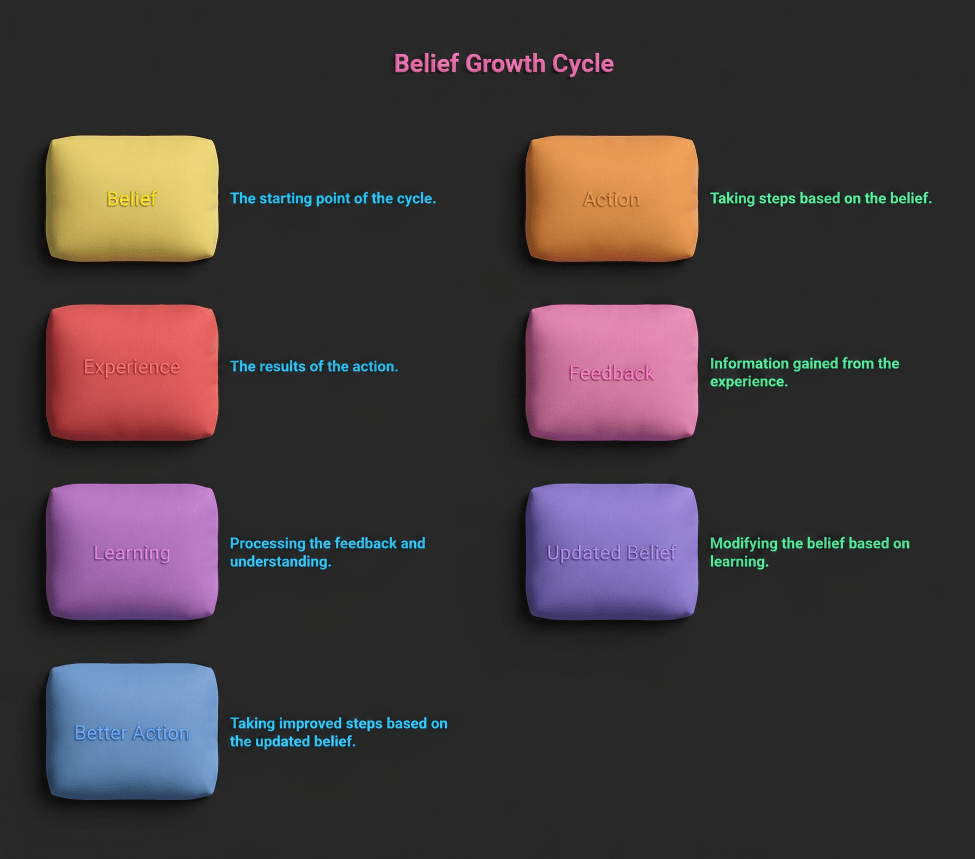
The most successful individuals repeat this cycle throughout their lives.
Final Reflection: What Beliefs Are Shaping Your Future?
Every major decision in your life and business is influenced by beliefs.
Some are helping you move forward.
Some may be quietly holding you back.
The goal is not to eliminate beliefs. The goal is to use them wisely.
Treat them as tools.
Test them.
Refine them.
Replace them when necessary.
The earlier we learn this lesson, the greater the compounding benefits in our careers, relationships, leadership journeys, and entrepreneurial ventures.
Before you leave, take a few minutes to reflect:
Which belief has had the greatest impact on your life?
Which belief might be preventing your next level of growth?
Write it down. Examine it. Test it.
That simple exercise could become the starting point of a major transformation.
Join the Conversation
I’d love to hear your thoughts.
What is one belief you once held strongly that later turned out to be inaccurate?
Share your experience in the comments section below. Your story may help another reader gain a valuable perspective.
If you found this article useful, please share it with at least one person who could benefit from understanding the difference between belief and truth.
And if you haven’t already, subscribe through the email Subscription Box at the bottom of the page to receive future insights on leadership, personal growth, entrepreneurship, and practical wisdom delivered directly to your inbox.
Sometimes a single shift in belief can change the direction of an entire life. The question is: Which belief will you examine today?
Stay tuned!!









Leave a Reply