

Have you ever walked into a meeting, looked around the room, and wondered, “What am I doing here? Everyone else seems smarter than me.” If so, you’re not alone.
A study published in the International Journal of Behavioral Science found that approximately 70% of people experience imposter syndrome at some point in their lives. Surprisingly, this includes highly accomplished professionals, executives, entrepreneurs, and even world-class performers.
Early in my career, I remember being invited to participate in a strategic discussion with senior leaders. Despite years of hard work and proven results, my first thought wasn’t excitement—it was fear. I felt certain someone would eventually discover I wasn’t qualified to be there. Looking back, I wasn’t lacking capability; I was experiencing imposter syndrome.
Over time, I learned a powerful lesson: successful people aren’t those who know everything. They’re often the ones who embrace intellectual humility—the willingness to learn, adapt, and accept that no one has all the answers.
Understanding the difference between these two mindsets can dramatically influence your personal growth, leadership journey, and business success.
What Is Intellectual Humility?
Intellectual humility is the ability to recognize that your knowledge has limits while remaining open to learning from others.
It doesn’t mean thinking less of yourself. It means thinking more accurately about what you know and what you still need to learn.
A Simple Everyday Example
Imagine a parent helping their child with homework. The child asks a question the parent cannot answer.
An intellectually humble response is:
“I’m not sure, but let’s find out together.”
The parent doesn’t pretend to know everything. Instead, they model curiosity and continuous learning.
Psychologist Adam Grant, author of Think Again, highlights a similar idea:
“The hallmark of wisdom is knowing you might be wrong.”
This mindset creates growth because it encourages learning instead of defensiveness.
Why It Matters
People with intellectual humility:
- Learn faster.
- Build stronger relationships.
- Make better decisions.
- Adapt more effectively to change.
- Become more trusted leaders.
What Is Imposter Syndrome?
Imposter syndrome is the persistent feeling that your success is undeserved, despite clear evidence of your competence and achievements.
People experiencing imposter syndrome often believe they have somehow fooled others into overestimating their abilities.
A Simple Everyday Example
A university student earns top grades throughout the semester.
Instead of feeling proud, they think:
“I just got lucky. Next time everyone will realize I’m not actually smart.”
Notice the difference.
The problem isn’t lack of ability. The problem is the inability to acknowledge genuine capability.
The Hidden Cost
Imposter syndrome can lead to:
- Chronic stress
- Burnout
- Missed opportunities
- Fear of speaking up
- Overworking to prove worth
Rather than motivating growth, it often creates unnecessary emotional barriers.
The Key Difference: Growth vs. Fear
At first glance, intellectual humility and imposter syndrome can appear similar because both involve recognizing limitations.
The difference lies in interpretation.
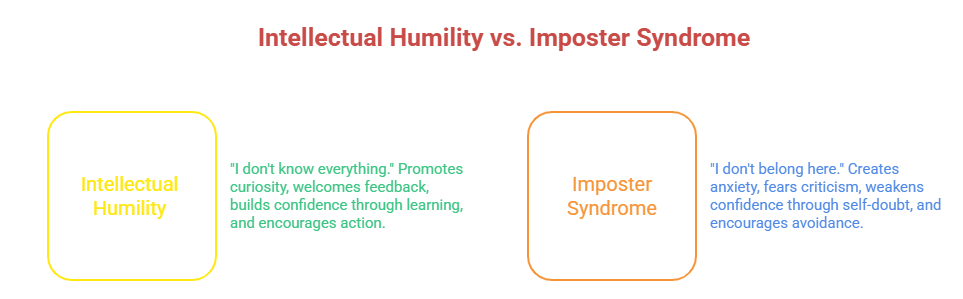
A helpful way to remember this is:
Intellectual humility says, “I still have more to learn.”
Imposter syndrome says, “I’m not capable enough.”
One opens doors. The other closes them.
Why Understanding This Early in Life Creates Massive Long-Term Benefits
Small beliefs create large outcomes over time.
Imagine two young professionals beginning their careers.
The first person asks questions, seeks mentorship, and admits when they don’t know something. The second avoids asking questions because they fear looking incompetent.
Five years later, who is likely to have grown more?
The answer is obvious.
Intellectual humility creates a learning advantage that compounds every day. Like earning interest on an investment, each lesson builds upon previous lessons.
This principle extends beyond careers.
In relationships, intellectually humble individuals communicate more openly.
In education, they learn more effectively.
In personal development, they remain adaptable instead of rigid.
The earlier this mindset is adopted, the greater the long-term benefits.
How Intellectual Humility Creates Exceptional Leaders
Many people assume great leaders are those with all the answers.
Reality often tells a different story.
The best leaders create environments where people feel safe contributing ideas, challenging assumptions, and sharing concerns.
Leadership in Action
Imagine a project manager leading a team through a difficult challenge.
One leader says:
“Follow my instructions. I know what works.”
Another says:
“Here’s my perspective. What am I missing?”
Which leader is more likely to uncover valuable insights?
The second leader encourages collective intelligence.
Research from Harvard Business School consistently shows that leaders who demonstrate humility improve team performance, innovation, and trust.
Employees don’t expect perfection.
They appreciate authenticity.
How Intellectual Humility Impacts Entrepreneurs and Businesses
Entrepreneurship is essentially a continuous learning process.
Markets change.
Customers change.
Technology changes.
Founders who refuse to adapt often struggle regardless of how intelligent they are.
A Business Reality Check
Many startups fail because founders become attached to their original ideas rather than listening to customer feedback.
Intellectually humble entrepreneurs recognize when adjustments are necessary.
They ask:
- What are customers telling us?
- What assumptions are wrong?
- What can we improve?
This mindset reduces costly mistakes and increases innovation.
Business success rarely belongs to those who know everything.
It often belongs to those who learn the fastest.
Lessons from Successful Indian Business Leaders
Ratan Tata
Ratan Tata is widely respected for his willingness to listen, learn, and remain approachable despite extraordinary success.
His leadership demonstrated that humility and ambition can coexist.
N. R. Narayana Murthy
The Infosys founder built a culture focused on transparency, learning, and continuous improvement.
His success came not from claiming all the answers but from empowering talented people around him.
Sridhar Vembu
Zoho founder Sridhar Vembu challenged conventional thinking by building a global technology company while staying deeply connected to grassroots realities.
His approach reflects intellectual humility in action: question assumptions, stay curious, and keep learning.
A Practical 7-Step Action Plan
1. Replace “I Must Know” with “I Can Learn”
When assigned a new project, avoid panicking because you lack expertise.
Instead, ask:
“What do I need to learn first?”
2. Ask One More Question
During meetings, challenge yourself to ask at least one thoughtful question.
Questions create learning opportunities.
3. Separate Mistakes from Identity
Missed a deadline?
You made a mistake.
You are not a mistake.
4. Request Monthly Feedback
Ask a colleague:
“What’s one thing I could do better?”
Small improvements compound quickly.
5. Keep a Success Journal
Record achievements, lessons learned, and positive feedback.
This helps counter imposter syndrome with evidence.
6. Challenge Negative Self-Talk
Whenever you think:
“I don’t belong here.”
Ask:
“What facts support that belief?”
Often, you’ll discover there aren’t many.
7. Adopt a Beginner’s Mindset
Approach every new situation with curiosity rather than judgment.
The goal isn’t proving intelligence.
The goal is expanding it.
Conclusion
Intellectual humility and imposter syndrome may appear similar on the surface, but they lead to very different destinations.
One mindset says, “I don’t know everything, but I can learn.”
The other says, “I don’t know enough, so I don’t belong.”
The first creates growth, confidence, resilience, and leadership. The second creates fear, hesitation, and self-doubt.
The most successful leaders, entrepreneurs, and lifelong learners understand that true confidence isn’t pretending to have all the answers. It’s having the courage to keep learning.
If there’s one lesson to carry forward, let it be this:
Your value doesn’t come from knowing everything. It comes from being willing to learn anything.
Join the Conversation
Have you ever experienced imposter syndrome in your career, business, or personal life? What helped you overcome it?
Share your thoughts and experiences in the comments section below. Your story may encourage someone else who is facing the same challenge.
If you found this article valuable, please share it with at least one person who could benefit from understanding the difference between intellectual humility and imposter syndrome.
And if you haven’t subscribed yet, enter your email in the Subscription Box below to receive future articles on leadership, entrepreneurship, personal growth, and practical life lessons directly in your inbox.
Stay tuned!!







Leave a Reply