

Every Sunday, I find myself reflecting on the conversations I’ve had during the week—many of them with young professionals, founders, and first-time leaders.
One question appears repeatedly, sometimes directly, sometimes between the lines:
“Should I become a generalist or a specialist to succeed?”
After more than three decades in healthcare—and working closely with leaders across industries—I’ve learned this:
this is not just a career decision. It’s a life-shaping choice.
Key takeaway: The question is not which one is better, but when and how each matters.
Two Paths I’ve Personally Seen Play Out
Early in my career, I worked with two colleagues at very different ends of the spectrum.
- One was a brilliant specialist. His knowledge in a specific clinical process was unmatched. Whenever there was a problem, everyone turned to him.
- The other was a quiet generalist. He understood workflows, people, finances, and constraints. When teams clashed or systems broke, he brought alignment.
Both were respected.
But their influence showed up at different moments.
Key takeaway: Success doesn’t come from choosing one path—it comes from knowing which path serves the moment.
What Truly Separates a Generalist from a Specialist
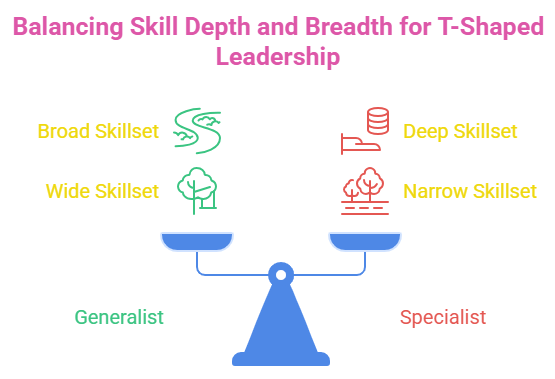
Specialists
- Deep expertise
- High credibility in a narrow area
- Precision and reliability
Generalists
- Broad understanding
- Ability to connect dots
- Comfort with ambiguity
A simple analogy:
- A pilot must master flying (specialist).
- An airline CEO must understand safety, finance, people, regulation, and customer experience (generalist).
Both roles are critical.
Confusing one for the other creates frustration.
Key takeaway: Depth builds trust; breadth builds context.
Why the Combination Always Wins
Here is a truth I’ve repeatedly seen in real life:
A specialist who also understands the bigger picture consistently outperforms a pure specialist or a pure generalist.
Why?
Compared to a pure specialist
A combined leader:
- Anticipates downstream impact
- Communicates better with non-experts
- Makes decisions that work beyond their own function
Pure specialists may solve their problem well—but sometimes create problems elsewhere.
Compared to a pure generalist
A combined leader:
- Commands deeper trust
- Makes sharper, faster decisions
- Is taken seriously during critical moments
Pure generalists may connect ideas—but struggle when depth is required.
Key takeaway:
Depth without context is narrow.
Breadth without depth is fragile.
The combination is powerful.
An Important Perspective: T-Shaped Leadership
There is one leadership idea that brings generalists and specialists together beautifully—T-shaped leadership.
- The vertical bar of the “T” represents deep expertise in one area.
- The horizontal bar represents a working understanding of multiple disciplines—people, operations, finance, technology, and strategy.
In my experience, the most effective leaders are T-shaped.
They:
- Earn respect because they have depth
- Build trust because they understand the whole system
- Lead specialists without threatening them
I’ve seen this work not just in healthcare, but in:
- Technology (engineers who learn business)
- Manufacturing (operations leaders who understand people)
- Startups (founders who balance product depth with market awareness)
Key takeaway: T-shaped leaders don’t know everything—they know what matters.
When Being a Generalist Is a Strength
In early career stages, generalist thinking is not a weakness—it’s a foundation.
This is when you should:
- Explore different roles
- Learn how decisions affect others
- Build communication and people skills
Many young professionals worry they are “too scattered.”
What I often tell them is simple:
Exploration is not lack of focus. It is preparation for focus.
Key takeaway: Breadth early prevents regret later.
When Specialization Becomes Essential
As careers progress, depth becomes the differentiator.
I’ve seen individuals stagnate because they avoided committing to a specialty.
I’ve also seen rapid growth once someone decided:
“This is where I will go deep.”
Specialization brings:
- Identity
- Confidence
- Long-term relevance
This applies equally to:
- Doctors
- Engineers
- Consultants
- Business owners
Key takeaway: Depth creates value others are willing to pay for.
Lessons from Indian Leaders Across Industries
Successful Indian leaders often evolved naturally into T-shaped leaders:
- Ratan Tata: Deep business understanding with a broad human and societal vision.
- Narayana Murthy: Systems and discipline combined with leadership values.
- Dr. Devi Shetty: Clinical mastery combined with scalable healthcare thinking.
They didn’t chase labels.
They responded to responsibility.
Key takeaway: Leadership maturity comes from evolution, not positioning.
Why This Matters in Every Industry Today
In today’s world:
- Pure specialists risk becoming isolated.
- Pure generalists risk becoming replaceable.
T-shaped leaders remain relevant because they:
- Adapt to change
- Collaborate across functions
- Think long-term
Whether you’re in healthcare, technology, education, finance, or a family business—this balance matters.
Key takeaway: Relevance comes from balance.
Conclusion: A Simple Summary to Remember
- Start wide
- Go deep
- Lead broad again
Generalist or specialist is not a permanent identity.
It’s a phase in a longer leadership journey.
Understanding this can save years of confusion and accelerate meaningful impact.
👉 I would truly value your perspective—please share your thoughts in the comment section below.
👉 If this article helped you, please share it with at least one person who might be struggling with this decision.
👉 And if you haven’t yet, do subscribe via email in the Subscription Box at the bottom of the page for future Sunday reflections.
Let’s keep learning—and leading—with clarity.
Stay tuned!!







Leave a Reply