

We live in a world where things tend to fall apart if left alone. Your desk gets messy, your fitness fades, your business strategies become outdated—all without anyone doing anything wrong. That’s entropy at work. But what if we could use this natural law to our advantage and lead in a way that works with it intentionally?
Understanding entropy doesn’t require a degree in physics. It simply takes a shift in how we view order, effort, and inevitable decline. In this article, we’ll explore how to embrace entropy—not fear it—and use it to build a more resilient, responsive life and business.
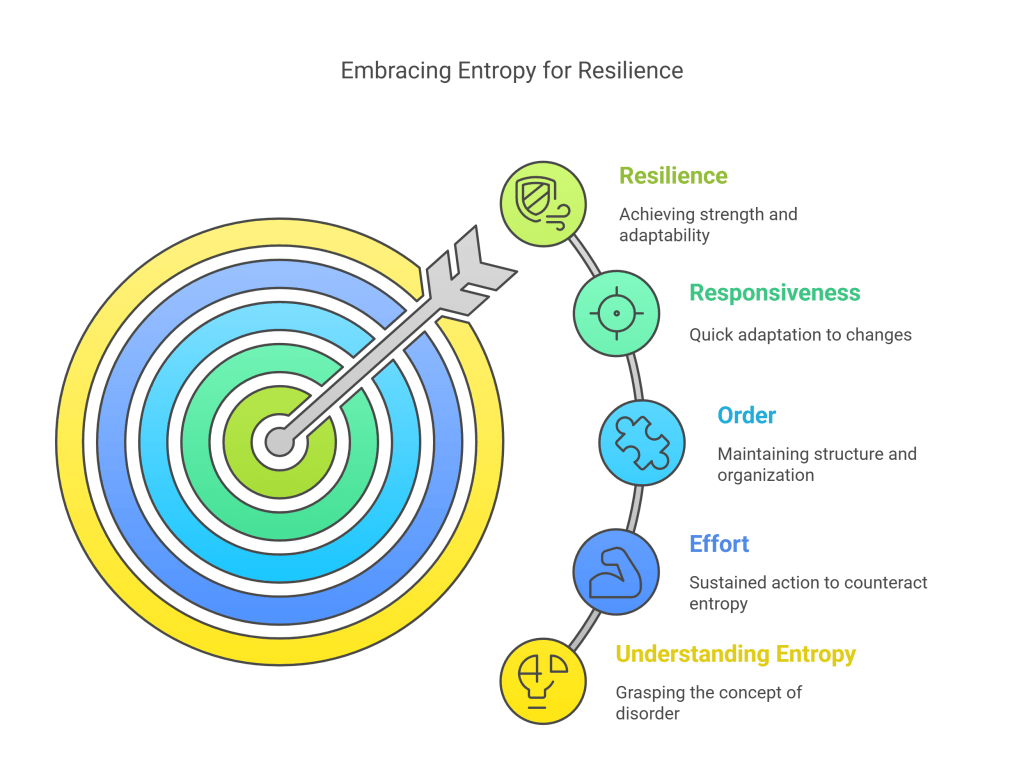
Understanding Entropy – The Basic Concept
What Is Entropy in Simple Terms?
Entropy, at its core, is a measure of disorder or randomness. The higher the entropy, the more chaotic a system becomes. Imagine a tidy room. Over time, without anyone cleaning it, it naturally becomes messy. That’s entropy in action.
Now think bigger. Entropy explains why everything—from ice cubes melting to relationships drifting apart—tends toward disorder unless energy is constantly applied to maintain order.
In simpler words: things fall apart if you don’t take care of them.
It applies to your physical health, mental focus, the quality of your friendships, and your business processes. Entropy is not just a scientific theory—it’s a life reality. And it’s always in motion.
The Origins of Entropy in Physics
In the 19th century, a German physicist named Rudolf Clausius introduced the concept of entropy in thermodynamics. He used it to describe how heat and energy move through a system. The Second Law of Thermodynamics tells us that systems naturally progress toward more disorder unless energy is added.
While that may seem like a scientific concern, it’s relevant to anyone trying to keep their calendar organized, house clean, or company competitive.
Entropy means everything drifts toward chaos. But if you understand this drift, you can build systems to work with it, not against it.
Entropy Beyond Science – Its Relevance in Everyday Life
You don’t need a physics degree to witness entropy. Look at your morning routine. If you don’t intentionally structure it, distractions creep in. Deadlines pile up. You end up late, tired, and stressed.
Or think about your friendships. Without regular check-ins or shared experiences, they fade over time—not because of conflict, but because of entropy.
In a world ruled by entropy, effort is your only defense. And effort, when directed smartly, builds habits and systems that resist decay.
The Unseen Presence of Entropy in Life
Chaos as the Default State of the Universe
Entropy isn’t the exception; it’s the rule. Chaos is not a glitch in the system—it is the system unless you do something about it. Life doesn’t naturally organize itself. Your time doesn’t manage itself. Your goals don’t achieve themselves.
This might sound depressing at first, but it’s actually freeing. When you stop expecting things to stay in place without effort, you stop blaming yourself or others when things start to slide. You understand: it’s not your fault—it’s entropy.
Once you acknowledge that, you’re better prepared to face it head-on.
Why Relationships, Habits, and Health Deteriorate Without Effort
Have you ever lost touch with a good friend without meaning to? Or fallen out of shape even though nothing drastic changed in your life? That’s entropy in real-time.
Relationships deteriorate without nurturing. Habits fade if not maintained. Health declines without proactive effort.
It’s not about blaming yourself for “letting go.” It’s about recognizing that without intention, things unravel. And when you understand that, you can take small, consistent actions to keep things together.
The Role of Entropy in Personal Growth and Decline
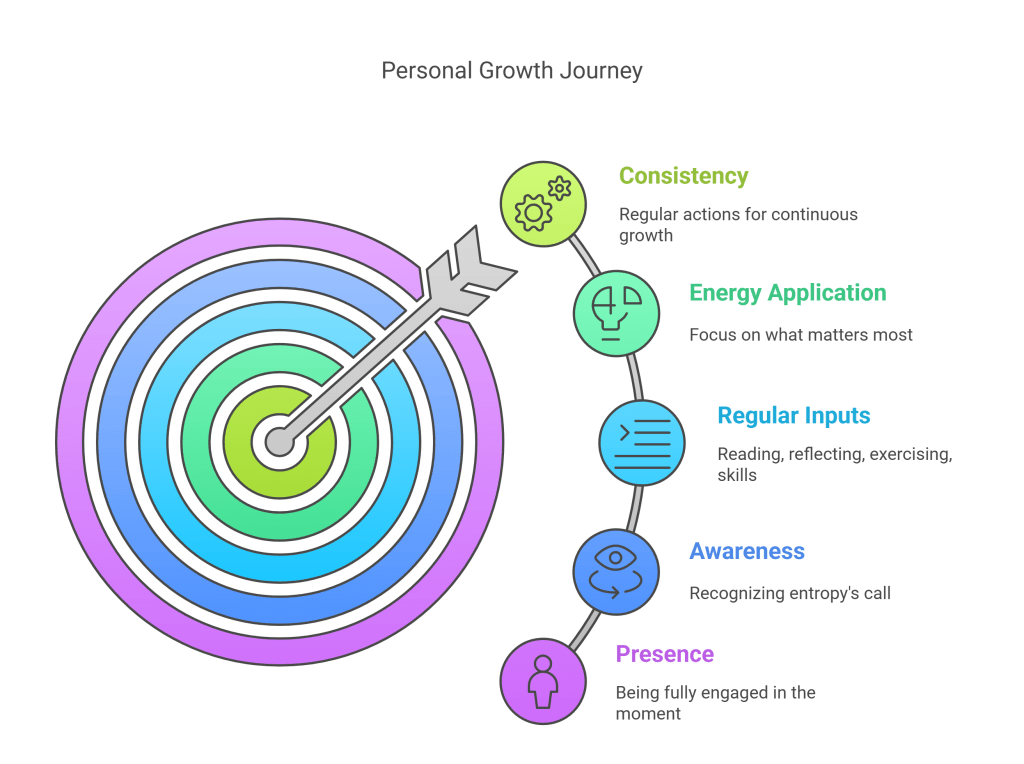
Personal growth isn’t a straight line. It’s more like climbing up a down escalator. If you pause or stop, you don’t stay in place—you move backward. That’s entropy.
If you want to grow—mentally, emotionally, spiritually—you need regular inputs: reading, reflecting, exercising, building skills. And when life feels overwhelming or off-balance, it’s often entropy creeping in, asking, “Are you still paying attention?”
But here’s the beautiful part: you don’t need to be perfect—just present.
Small, regular actions beat grand but rare gestures. It’s not about mastering life overnight. It’s about showing up consistently and applying energy where it matters.
How Entropy Affects Businesses and Organizations
Workplace Culture Without Maintenance
Culture isn’t a one-time setup. It’s like a garden—if you don’t regularly weed and water it, the bad stuff grows. Entropy means that without deliberate attention, good company culture declines. Gossip creeps in. Silos form. Innovation dries up.
You don’t need a crisis for things to fall apart. You just need inattention.
Great leaders understand this. They know that culture needs constant care, communication, and alignment. They don’t wait for issues—they actively prevent them by staying engaged.
How Systems and Strategies Fall Apart Over Time
Your business systems—sales funnels, onboarding processes, customer support—are all vulnerable to entropy. Without regular reviews, updates, and tweaks, even the best systems become inefficient or irrelevant.
Remember: entropy is always working. If your business isn’t evolving, it’s decaying.
Leaders who thrive aren’t those who create the perfect system once. They’re the ones who check in constantly, fix issues early, and stay curious about how things can work better.
The Cost of Ignoring Entropy in Business Operations
When businesses ignore entropy, it shows up in missed deadlines, bloated budgets, and unhappy customers. It leads to turnover, burnout, and lost market share.
The cost isn’t just financial—it’s cultural. Teams lose morale when things feel chaotic or broken. Clients lose trust when quality slips.
Ignoring entropy doesn’t make it go away. It just gives it more power.
Learning from Successful Leaders Who Tame Entropy
Steve Jobs and the Discipline of Design
Steve Jobs didn’t just design beautiful products. He designed systems that demanded clarity and excellence. From how products were created to how employees communicated, everything had a structure that pushed back against entropy.
He understood that simplicity isn’t easy—it’s the result of intense effort. Every decision—from typography to supply chain—was about reducing chaos and creating elegance through order.
Jobs didn’t fight entropy with control. He fought it with intentional design.
Elon Musk and the Relentless Reinvention of Systems
Elon Musk doesn’t let systems sit still. Whether it’s manufacturing cars or launching rockets, he believes in continuous improvement. Musk expects systems to fail if left unchecked—and so he builds feedback loops to keep upgrading.
He famously said, “The best process is no process.” But what he really means is: if a system isn’t working, scrap it and build something better.
That’s how you beat entropy in business—not with complacency, but with curiosity and constant reinvention.
Angela Merkel: Order in Leadership Amid Chaos
Angela Merkel led Germany through financial crises, a refugee influx, and global uncertainty—not with flashiness, but with calm, deliberate leadership. Her superpower? Creating stability amid entropy.
She didn’t overreact to chaos. She understood that order is built through patience, data, and reasoned decisions. In turbulent times, that kind of leadership becomes a lighthouse.
Merkel shows that you don’t need to be loud to be strong. You just need to be consistent and grounded.
Practical Applications – Using Entropy to Your Advantage
Designing Self-Sustaining Systems
Want to outsmart entropy? Build systems that don’t rely solely on willpower or constant micromanagement. Think of self-sustaining systems like autopilot for your goals. Whether in life or business, the trick is to create structures that automatically pull you back into alignment.
For instance, automate bill payments so finances stay on track. Use digital reminders for follow-ups. Set up recurring meetings with your team to catch issues early. Create habits and routines that don’t ask for daily decisions.
In business, this might look like templates for onboarding new employees or scheduled performance reviews. These systems don’t remove entropy entirely—but they buffer you against its damage.
Tip: Always ask, “How can I make this process run without me?” That question leads to sustainability.
Building Habits that Resist Decay
Habits are your personal defense against entropy. Want a healthy body, a sharp mind, or strong relationships? You need habits. Not one-time decisions, but repeated actions that become automatic.
The key is consistency, not intensity. A 10-minute walk daily is better than a 1-hour workout once a month. Checking in with a friend weekly is more powerful than a yearly apology text.
To build strong habits:
- Start small. (Don’t run a marathon. Just lace up your shoes.)
- Make it easy. (Put your gym clothes where you can see them.)
- Track it. (Use a journal or app to stay accountable.)
Entropy wants to undo your progress. Your job? Show up daily, even in small ways.
Creating Cultures That Self-Correct
In both families and companies, culture either lifts you up or drags you down. If you want a group to resist entropy, you need shared values and systems of feedback.
Great cultures self-correct. They encourage honesty. They reward improvement. They make it okay to fail—but not okay to hide.
How do you build that?
- Set clear values—and live by them.
- Invite feedback from all levels.
- Celebrate accountability, not just results.
When culture becomes a shared responsibility, it becomes a living system. And living systems adapt, evolve, and survive.
Step-by-Step Action Plan for Individuals
Step 1 – Accept the Reality of Entropy
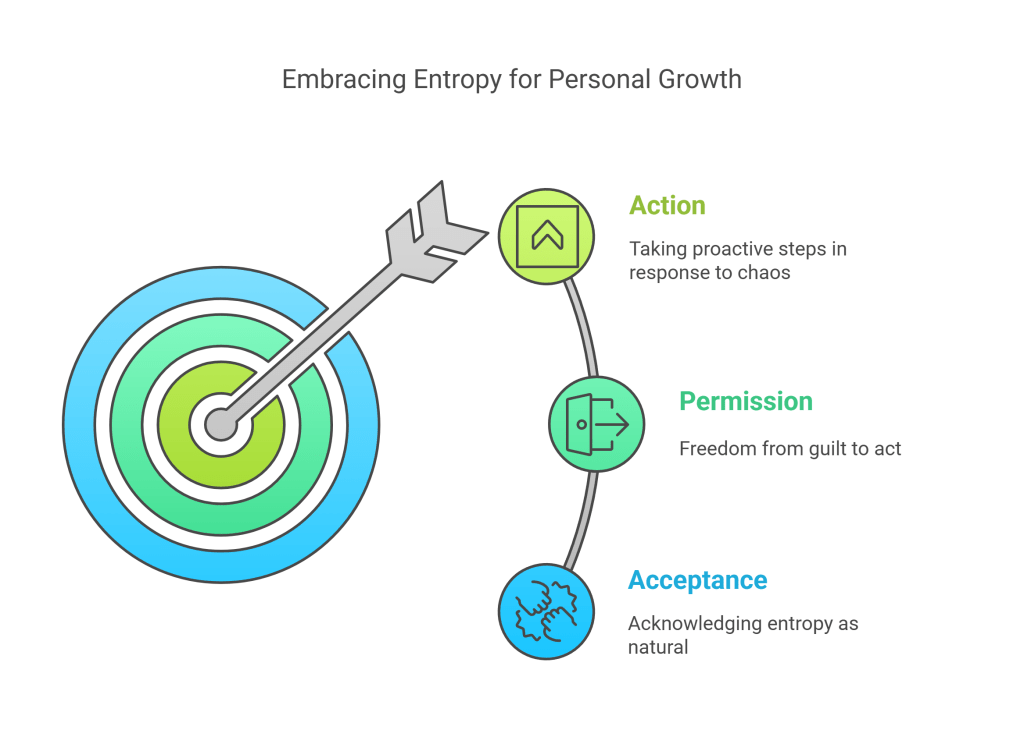
First things first: let go of the illusion that things will stay fine on their own. Accept that entropy is natural. When you embrace that truth, you stop being surprised when things slip—and you start preparing for it.
Don’t take chaos personally. Instead, treat it as part of the rhythm of life. Messiness, distractions, emotional dips—they’re all signs that it’s time to apply energy again.
This mental shift frees you from guilt and gives you permission to act. You’re not broken—you’re living in an entropic world.
Step 2 – Audit the Chaos in Your Life
Where are things slipping? Your health? Your finances? Your relationships?
Create a quick personal entropy audit:
- List the key areas of your life (mind, body, work, relationships, space).
- Score each area from 1 to 10 on how “in order” it feels.
- Ask: What’s one small habit that would reduce chaos here?
You’ll likely find that the areas causing you stress are the ones with no system, no routine, and no attention. That’s entropy winning. But it’s fixable.
This step is like turning on a light in a messy room. Suddenly, you can see clearly—and start cleaning up.
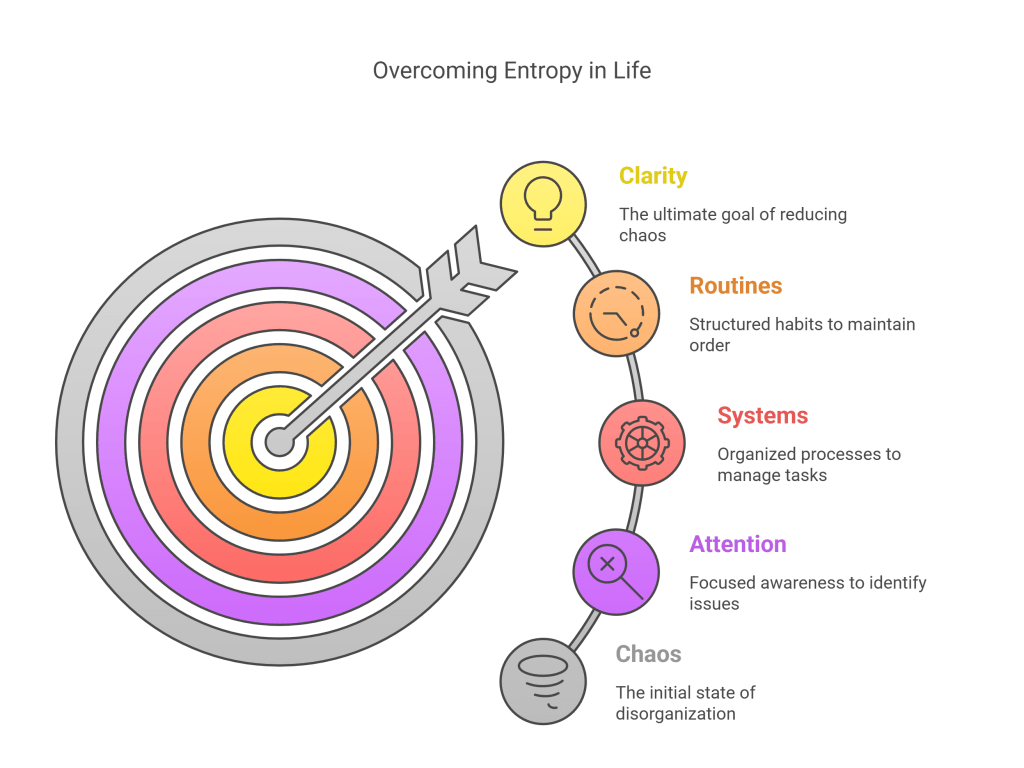
Step 3 – Introduce Simple, Sustainable Routines
Start small. Overhauls rarely stick. Pick one or two areas from your audit and add light structure.
Examples:
- Make your bed every morning (reduces visual chaos).
- Do a 5-minute journal check-in at night (reduces mental chaos).
- Have a 15-minute Sunday planning session (reduces time chaos).
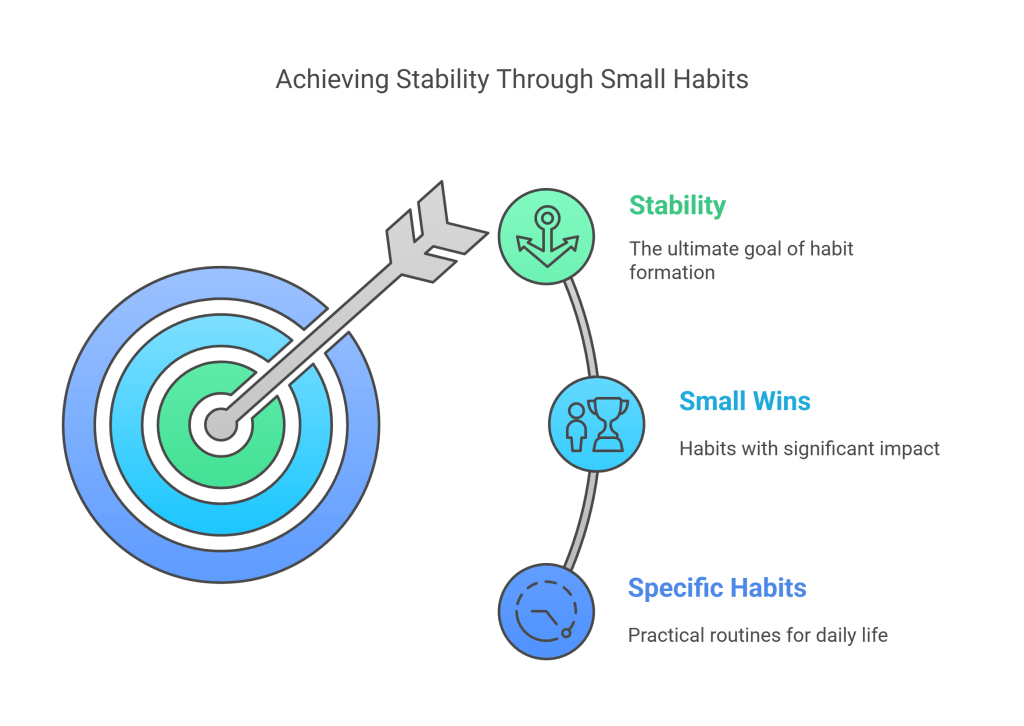
Focus on small wins with big impact. These routines anchor your day. They keep entropy from running wild and gently guide you back to stability.
And remember: progress over perfection. Miss a day? That’s fine. Keep showing up.
Step 4 – Maintain, Adjust, Evolve
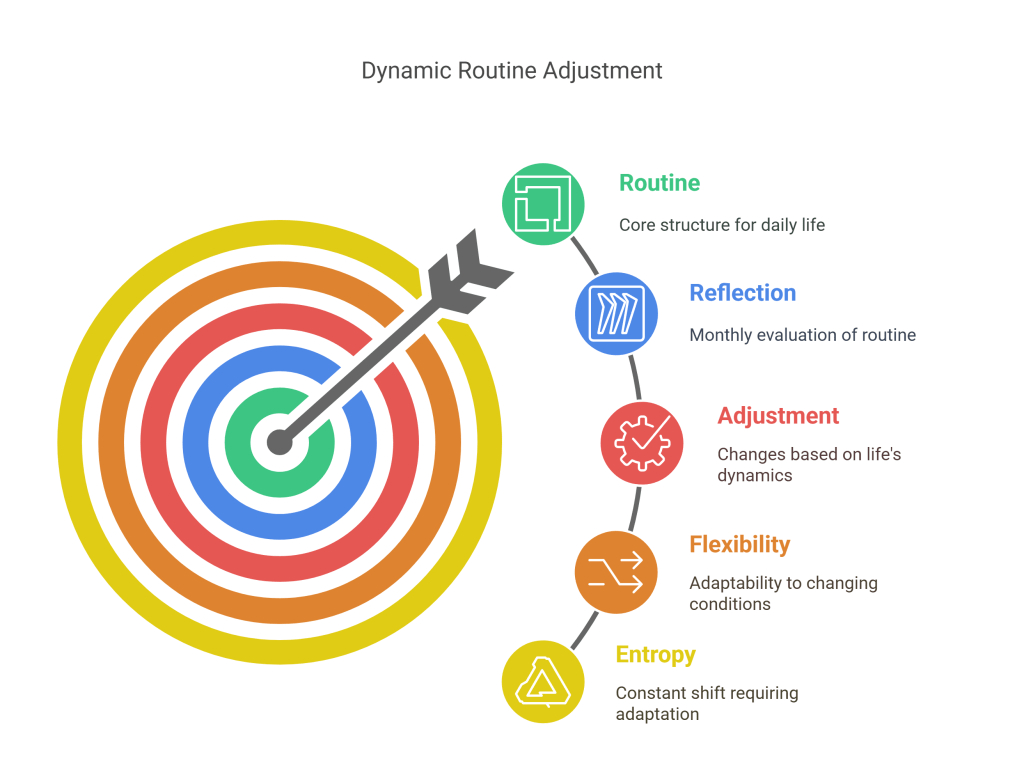
Routine isn’t a cage. It’s a launchpad. But even the best systems need tweaking.
Every month, reflect:
- What’s working?
- What’s slipping?
- What needs to change?
Life is dynamic. So your routines should be too. Adjust your approach based on season, energy, and priorities. Be flexible—but never complacent.
Entropy is always shifting. So should you.
Step-by-Step Action Plan for Businesses
Step 1 – Identify Key Areas of Decay
Start by asking your team:
- What’s not working?
- Where are we losing time or energy?
- What’s frustrating our clients?
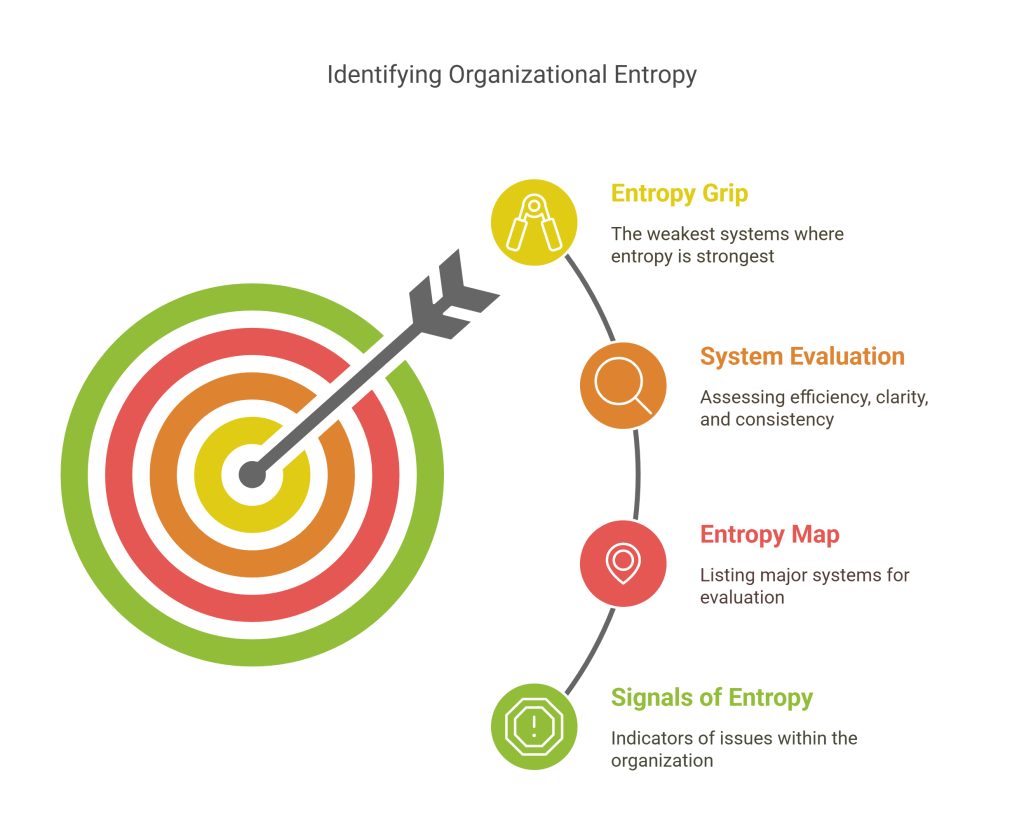
These are signals of entropy. Don’t ignore them.
Create an entropy map. List all your major systems (sales, HR, communication, marketing). Have your leadership rate each on efficiency, clarity, and consistency.
The weakest ones? That’s where entropy has the biggest grip.
Step 2 – Introduce Feedback Loops
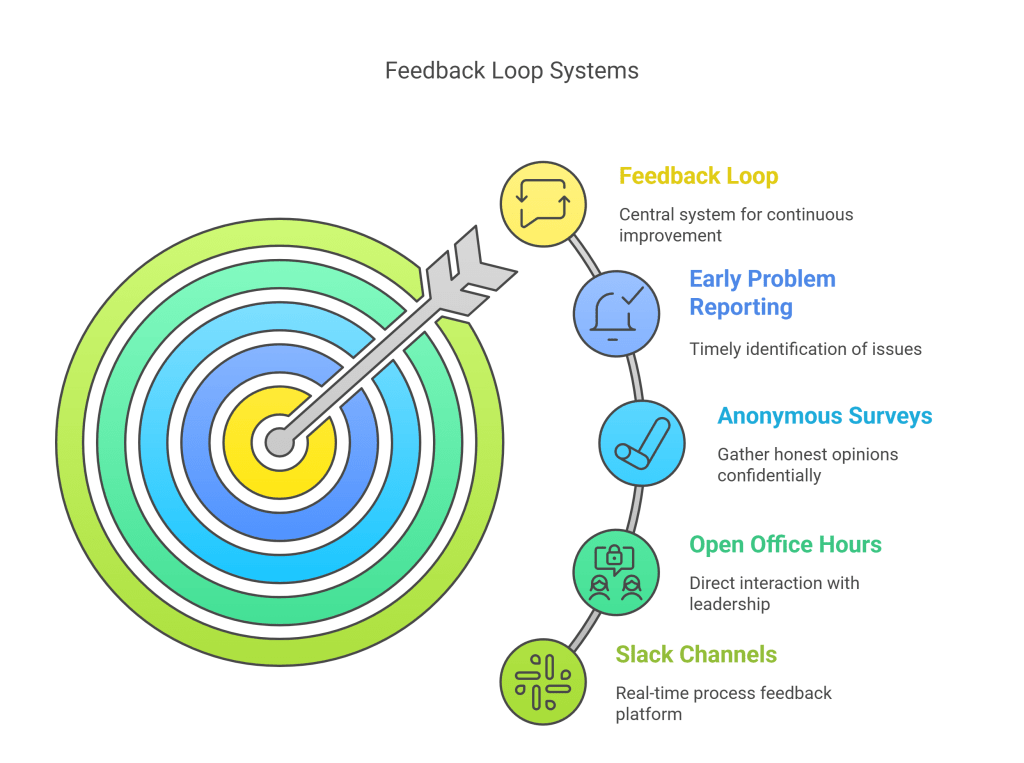
Feedback fights entropy. Create systems where your team can report problems early.
Try these:
- Monthly anonymous pulse surveys
- Open office hours with leadership
- Slack channels for process feedback
Make feedback safe and expected. If no one’s giving you feedback, entropy is probably winning in silence.
Feedback loops help you catch decay before it spreads. They turn your business into a living organism—constantly sensing and adjusting.
Step 3 – Systematize Regular Reviews and Maintenance
Businesses don’t break from big failures. They break from small breakdowns that no one fixes.
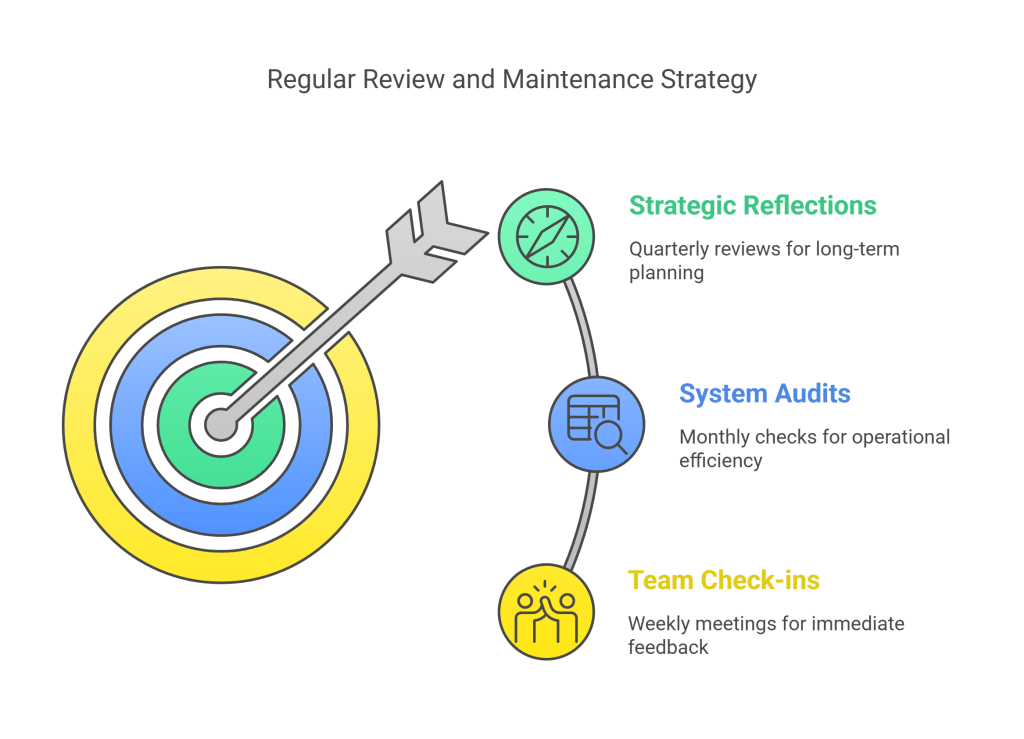
Schedule regular reviews:
- Weekly team check-ins
- Monthly system audits
- Quarterly strategic reflections
Make maintenance a calendar item—not a crisis response. It’s way cheaper to clean a filter regularly than to replace a broken engine.
Keep asking: What’s outdated? What’s overly complex? What’s not serving us anymore?
Step 4 – Cultivate an Anti-Entropy Culture
Leaders set the tone. If you’re chaotic, your team will be too. But if you’re intentional—open to feedback, focused on growth—your culture will mirror that.
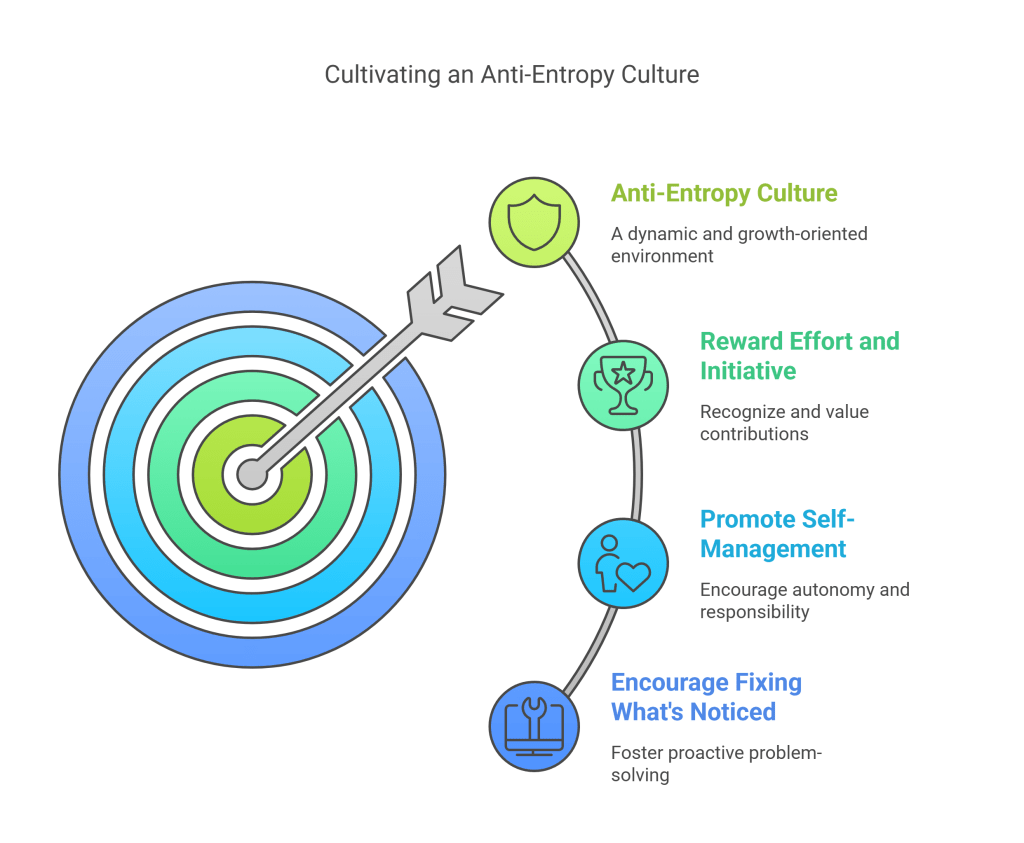
Here’s how to build an anti-entropy culture:
- Reward effort and initiative, not just outcomes.
- Promote self-management and personal accountability.
- Encourage people to fix what they notice.
When everyone’s paying attention, entropy doesn’t stand a chance.
Famous Quotes on Entropy and Order
Insightful Words from Physicists and Philosophers
- “The universe tends toward disorder. That’s entropy. Our job is to keep fighting it.” – Anonymous
- “Order is not pressure which is imposed on society from without, but an equilibrium which is set up from within.” – José Ortega y Gasset
- “Entropy is the price of structure.” – Ilya Prigogine
These thinkers remind us: entropy isn’t bad. It’s just the cost of being alive. Our job is to pay that cost—daily.
Business Leaders on Fighting Decline
- “If you don’t actively attack the process, the process will attack you.” – Jack Welch
- “If you want to stay in the game, keep reinventing the game.” – Jeff Bezos
- “Complacency breeds chaos. Attention breeds excellence.” – Howard Schultz
Leaders get it. You either manage entropy, or it manages you.
Embracing Entropy as a Guiding Principle
Entropy Isn’t the Enemy – It’s the Teacher
Here’s a mindset shift worth adopting: what if entropy isn’t something to fight against, but something to learn from?
Think of entropy as the universe’s way of nudging you toward attention and care. It’s like a personal trainer for your systems—pointing out where you’ve become too comfortable, too reliant on autopilot.
Anecdote:
Sarah, a marketing manager, used to resist entropy. When her team’s performance dipped, she doubled down on control, micro-managing everything. It led to burnout. One day, she stopped and asked herself: What if this decline is a signal, not a failure? That question changed everything. Instead of forcing her team to maintain outdated strategies, she opened the floor for innovation. The results? Happier staff, better results—and a business that evolved with entropy, not against it.
Reflective Question:
What’s one area in your life or business where resistance is exhausting you—when acceptance and adaptation could set you free?
Creating a Life and Business that Thrive in Change
Entropy means change is inevitable. But change doesn’t have to be chaos. In fact, some of the most beautiful things in nature are born from disorder—like a forest regrowing after a fire, or a butterfly emerging from a cocoon.
In life and business, success isn’t about preventing change. It’s about designing for it.
That means:
- Building flexible systems that adapt when pressure hits.
- Being emotionally resilient enough to pivot when things fall apart.
- Encouraging creativity when routine breaks down.
Example:
Netflix is a prime example. They didn’t cling to DVDs—they evolved into a streaming platform, and then a content producer. They embraced the entropy of the media world and shaped it into something new.
Tip:
Use entropy as a test. When something breaks, don’t just fix it—ask why it broke, and whether it’s time for something better.
Conclusion – Find Peace in the Pattern
Entropy teaches us that nothing stays perfect, and that’s okay. The messiness of life isn’t something to fear—it’s something to manage, moment by moment, with clarity, intention, and heart.
Whether it’s your morning routine, your career path, or the culture of your company, entropy is always at work. But so are you. And your power lies in choosing presence over perfection, systems over chaos, and adaptation over control.
Let entropy remind you to keep showing up. To keep refining. To keep caring.
Because life doesn’t demand you to stop the chaos—it asks you to meet it, shape it, and grow with it.
FAQs
What is a real-life example of entropy?
A kitchen left alone will eventually get messy, even if no one is cooking. That’s entropy—disorder naturally increasing over time without intentional effort to restore order.
How can I maintain order in my daily routine?
Start small with consistent actions like morning journaling, planning the night before, or decluttering for 5 minutes daily. These create anchors that prevent chaos from taking over.
What tools help reduce entropy in business?
Project management platforms (like Asana or Trello), automated reminders, SOPs (Standard Operating Procedures), and regular team check-ins help maintain structure and reduce breakdowns.
How can leaders model anti-entropy behaviors?
By showing up consistently, creating feedback-friendly environments, maintaining personal routines, and continuously evolving systems instead of letting them stagnate.
Can entropy be positive in any way?
Yes! Entropy often reveals what’s no longer working. It forces evolution. Think of it as nature’s way of saying: It’s time to grow, adapt, and redesign for what’s next.
I hope you found this article enlightening! Your feedback means a lot to us, so feel free to share in the comments below. If you think this article can help someone simplify their life, please share it with your community. We would be grateful! If you haven’t subscribed yet, we invite you to subscribe now. Enter your email in the subscribe box at the bottom of the page.
Stay tuned!






Leave a Reply