


A hiker walks between signs for “BEING LOVED” and “BEING IN LOVE” beneath a glowing mountain sunset.
What if one of the biggest differences between an ordinary life and a meaningful one is not how much love we receive, but how deeply we care about what we do?
Here, “being in love” has nothing to do with romantic relationships. It means being deeply connected to a purpose, craft, responsibility, people, values or mission. Being loved means receiving appreciation, acceptance, recognition or approval from others.
Both matter. But they create very different internal engines.
Being in Love vs Being Loved

Lush houseplants labeled “APPROVAL” and “PURPOSE” frame three friends sharing a joyful moment indoors.
Being loved often asks: “Do people appreciate me?”
Being in love asks: “Do I genuinely care about what I am doing?”
When you depend primarily on being loved, your confidence can rise and fall with applause. When you are in love with your purpose, you have an internal reason to continue even when nobody is clapping.
That distinction can quietly shape an entire lifetime.
The Impact in Personal Life

Three heartwarming scenes show kindness shared through neighbors, family, and practical skills.
Imagine two people volunteering in their community. One wants recognition and feels disappointed when nobody notices. The other genuinely cares about helping people and leaves satisfied even without praise.
The second person is operating from purpose rather than validation.
This does not mean ignoring appreciation. Human beings need connection. The lesson is simply not to make external approval the foundation of your identity.
When understood early, this mindset can influence daily choices—what you learn, whom you help, how you respond to failure and how consistently you show up.
The Impact in Business

A business professional stands in a collaborative workspace beside illuminated graphics highlighting customer, product, and mission priorities.
In business, being “in love” can mean caring deeply about solving a customer problem, building excellent products, developing people or creating something useful.
Consider two entrepreneurs. One starts a company mainly because entrepreneurship looks prestigious. The other becomes obsessed with solving a genuine problem.
When sales fall, the first may ask, “Why isn’t everyone appreciating me?” The second is more likely to ask, “What is wrong with the product, customer experience or strategy?”
That shift changes behaviour.
Love for the mission encourages learning; dependence on recognition can encourage defensiveness.
Why Understanding This Early Compounds

Wooden signs on snowballs illustrate how purpose, character, skill, and trust build results.
Small decisions repeated for years become a professional identity.
Someone who learns early to value curiosity over praise, contribution over status and mastery over appearance gradually develops stronger habits. Those habits influence relationships, leadership and career decisions.
This is the compounding effect: one useful belief can influence thousands of ordinary decisions.
You do not need to discover your ultimate purpose at 20. You need to become better at asking, “What is worth caring about deeply?”
Being in Love as a Leader

A group of hikers follows their guide through the forest as a lantern glows at dusk.
A leader who genuinely cares about the mission does not need to be the centre of every conversation.
Leadership becomes less about “How do I look?” and more about “How does the team succeed?”
This can appear in any position—a manager protecting team quality, a teacher developing students, a founder listening to customers or a senior executive developing future leaders.
The position may change. The principle remains.
Being in Love as an Entrepreneur

A startup team discusses product plans beside a detailed innovation and growth roadmap.
Entrepreneurs can lose enormous energy chasing funding announcements, social-media applause, titles and competitors.
A healthier question is: “What problem am I willing to work on repeatedly because I genuinely believe it matters?”
That does not replace financial discipline. A business still needs revenue, margins, customers and execution. Purpose without a viable business model is only an intention.
The strongest combination is care + competence + commercial discipline.
Lessons From Successful Leaders
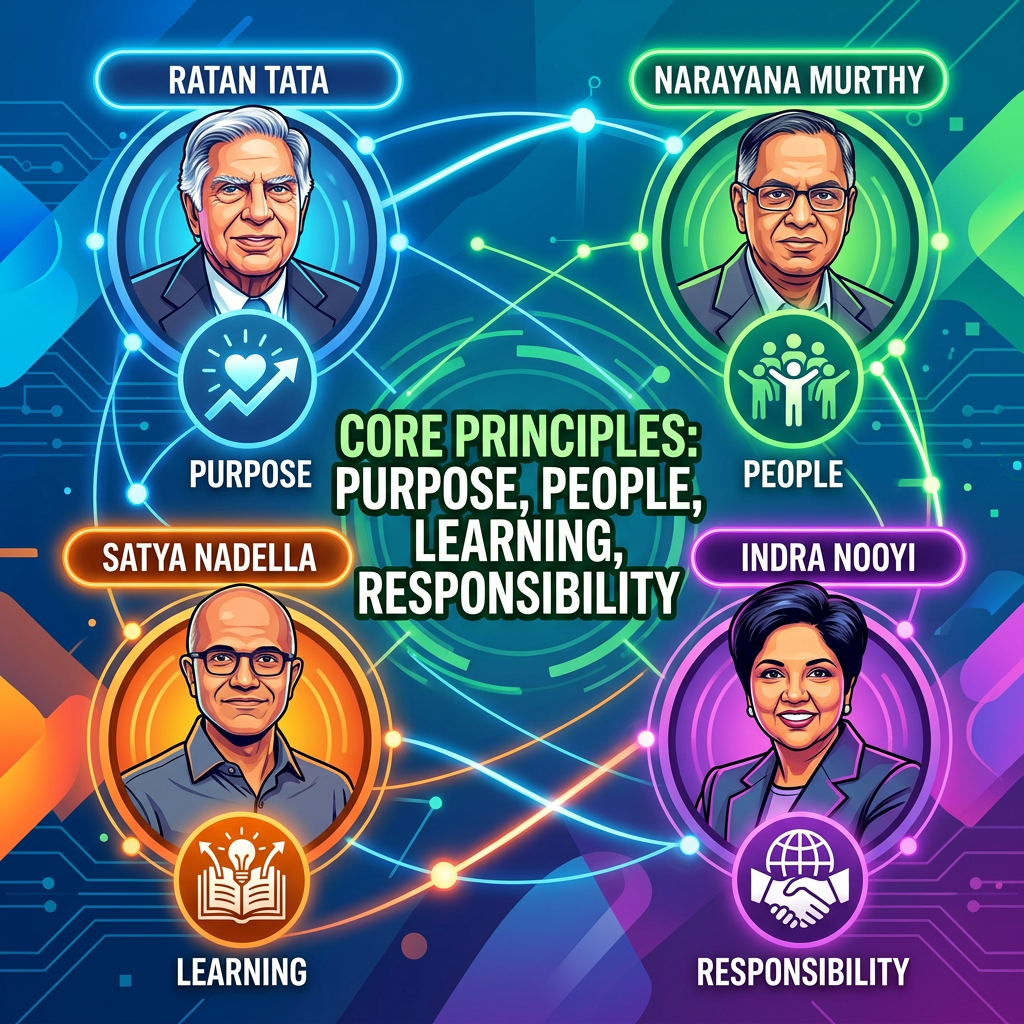
Four influential business leaders represent purpose, people, learning, and responsibility in a vibrant leadership framework.
Indian business leaders such as Ratan Tata became widely associated with values including institution-building, social responsibility and long-term thinking. N. R. Narayana Murthy has repeatedly emphasised professionalism, transparency and institutional values through his work at Infosys.
Internationally, Satya Nadella has spoken extensively about empathy and a growth mindset during his leadership at Microsoft. Indra Nooyi has discussed purpose, leadership and balancing business performance with broader responsibilities.
Their careers are different, but one useful lesson is consistent: meaningful leadership is larger than personal applause.
A 5-Step Action Plan

Stepping stones marked “CARE,” “LEARN,” “SERVE,” “BUILD,” and “REFLECT” cross a flowering garden stream.
1. Identify what you genuinely care about.
Write down three activities or problems that make you curious even without recognition.
2. Separate purpose from approval.
Before making an important decision, ask: “Would I still do this if nobody praised me?”
3. Turn care into skill.
Passion becomes valuable when converted into competence through deliberate practice.
4. Serve someone beyond yourself.
In business, identify one customer problem. In life, identify one person or community you can help.
5. Review every month.
Ask: “Am I building my life around what matters—or around what makes me look successful?”
Conclusion

A lone hiker follows a rocky mountain path toward a glowing sunset above the clouds.
Being loved can give us warmth. Being in love with a meaningful purpose can give us direction.
The goal is not to reject appreciation, recognition or success. It is to avoid becoming dependent on them.
When you learn to care deeply about your work, your people, your values and your contribution, daily actions begin to align. Over time, those small aligned actions can shape character, leadership and business outcomes.
What are you deeply “in love” with—not romantically, but in terms of purpose and contribution?
Please Share your thoughts in the comment section below. If this article reminds you of someone who needs this perspective, please share it with at least one person. And if you haven’t subscribed yet, enter your email in the Subscription Box at the bottom of the page so you don’t miss future articles.
FAQs
1. Does being loved have no value?
No. Appreciation and belonging are important. The point is that they should complement—not replace—your internal sense of purpose.
2. Can an entrepreneur be successful without loving the business?
Yes, but genuine interest in the problem being solved can make sustained learning and persistence easier.
3. Is being in love with your work the same as working constantly?
No. Purpose does not require burnout. Sustainable performance also requires rest, relationships and boundaries.
4. How can young professionals develop this mindset?
Start by choosing learning, contribution and integrity over short-term approval whenever the two come into conflict.
5. Can this principle apply to any profession?
Absolutely. A teacher, doctor, engineer, manager, artist, entrepreneur or employee can apply it by becoming deeply committed to meaningful contribution.
Stay tuned!!
Image Disclaimer: Images used in this article are provided for illustrative, educational, and informational purposes only. Any company names, brand names, logos, trademarks, products, services, or other identifiable brand elements appearing in an image are the property of their respective owners. Their inclusion does not imply any endorsement, sponsorship, partnership, affiliation, or association with the author, publisher, or this website. The images are intended solely to help explain or visualize the concepts discussed in the article.









Leave a comment