

Have you ever walked out of a meeting wondering, “Did I come across as confident… or did I overdo it?” You’re not alone. Most of us struggle to balance self-belief with humility, especially in high-pressure environments like business or leadership roles.
Confidence and arrogance often wear the same outfit—but they leave very different impressions behind. One opens doors. The other quietly closes them.
Let’s unpack this in a way that feels real, relatable, and actually useful in your everyday life.
Confidence vs Arrogance: What It Looks Like in Real Life
A few years ago, I sat in a team meeting where two managers presented their ideas.
The first spoke with clarity, acknowledged his team’s contributions, and even said, “I might be missing something—happy to hear your thoughts.” The room leaned in. People engaged.
The second manager? Equally knowledgeable, but his tone was dismissive. He interrupted others and brushed off suggestions. His message may have been strong—but the delivery created distance.
That’s the difference.
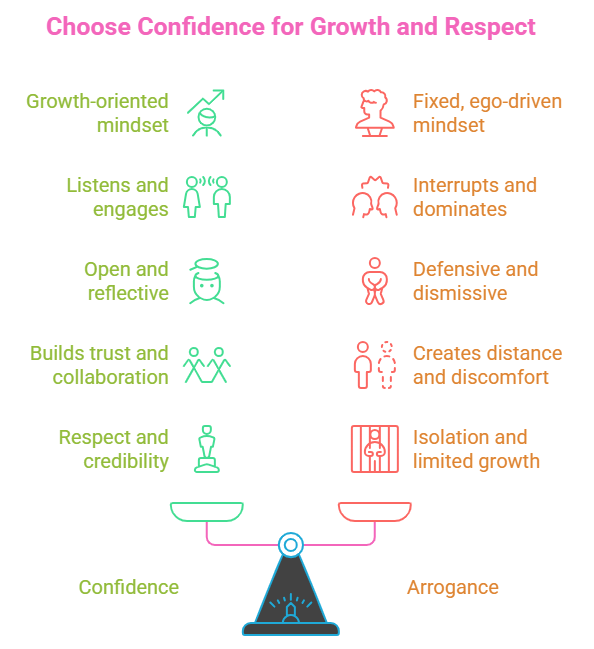
- Confidence says: “I believe in my abilities, and I’m open to learning.”
- Arrogance says: “I don’t need anyone else’s input.”
Confidence builds bridges. Arrogance builds walls.
Why This Difference Matters More Than You Think
In life, confidence helps you form deeper connections. People feel comfortable around you. They trust you.
In business, it becomes even more critical.
Imagine two leaders:
- One who listens, adapts, and empowers
- Another who dominates, dismisses, and dictates
Who would you rather work with?
A 2023 leadership study found that leaders who actively listen and show humility are 30% more likely to retain high-performing employees. That’s not just a personality trait—it’s a business advantage.
Arrogance might win attention in the short term. But confidence earns respect over time.
Lessons from Successful Indian Leaders
Let’s bring this closer to home.
Ratan Tata: Quiet Confidence That Speaks Volumes
Ratan Tata never needed to be the loudest voice in the room. His leadership style reflects calm decision-making and deep respect for people. Even after massive success, his humility remains intact. That balance is what earns long-term trust.
Indra Nooyi: Strength with Empathy
Indra Nooyi, former CEO of PepsiCo, was known for writing personal letters to employees’ families, appreciating their support. Think about that—global leadership paired with personal connection. That’s confidence grounded in humanity.
Narayana Murthy: Leading Without Ego
Murthy built Infosys with a focus on ethics and transparency. He didn’t position himself as the smartest person in the room but as someone committed to learning and building together.
Key takeaway: These leaders didn’t suppress their confidence—they refined it with humility.
Making It Practical: How This Shows Up Daily
Let’s make this real.
Scenario 1: Workplace Discussion
You present an idea, and someone challenges it.
- Arrogant response: “You don’t understand the bigger picture.”
- Confident response: “That’s an interesting point—let’s explore it.”
Same situation. Completely different outcome.
Scenario 2: Feedback from a Manager
You receive constructive criticism.
- Arrogant mindset: Defensive, dismissive
- Confident mindset: Curious, reflective
A friend once told me how this shift changed his career. Instead of pushing back during feedback sessions, he started asking, “What’s one thing I can do better immediately?” Within a year, he was promoted—not because he knew everything, but because he was willing to grow.
Step-by-Step Action Plan (With Real Application)
Let’s move beyond theory. Here’s how you can actively practice confident behavior without slipping into arrogance:
1. Start With Self-Check Moments
At the end of your day, ask:
- Did I listen more than I spoke?
- Did I dismiss anyone too quickly?
This simple habit builds awareness over time.
2. Use Language That Invites, Not Dominates
Instead of saying:
- “This is the only way.”
Try:
- “This is one approach—what do you think?”
This small tweak changes how people respond to you.
3. Practice “Pause Before Response”
In conversations, especially heated ones, pause for 2–3 seconds before replying. It prevents reactive, ego-driven responses.
4. Create a Feedback Loop
Reach out to 2–3 trusted people and ask:
“What’s one thing I do that might come across as arrogance?”
One professional I know did this and discovered he often interrupted others without realizing it. Fixing that one habit improved his relationships drastically.
5. Celebrate Others Publicly
Confident people shine a light on others.
Try this:
- Acknowledge a colleague’s effort in a meeting
- Appreciate contributions openly
It strengthens both relationships and team culture.
Visual Breakdown: Confidence vs Arrogance
A Simple Rule to Remember
Whenever you’re unsure, ask yourself:
👉 “Am I trying to connect, or am I trying to impress?”
Connection builds influence.
Impressing, when driven by ego, often backfires.
Conclusion
Confidence isn’t about being the loudest or the smartest—it’s about being secure enough to stay open. Arrogance, on the other hand, often hides behind insecurity and the need to prove.
The real power lies in knowing you’re capable without needing to constantly prove it.
As you move forward in your personal and professional journey, pay attention to the subtle cues—how you speak, how you listen, how you respond. These small moments define whether you’re building bridges or burning them.
Let’s Make This Interactive
I’d love to hear from you:
- Have you ever mistaken confidence for arrogance—or vice versa?
- What’s one situation where this distinction made a difference for you?
Share your thoughts in the comments section below—your experience might help someone else gain clarity.
And if this article made you pause and reflect, share it with at least one person who might need this perspective today.
Finally, if you haven’t already, subscribe through the email Subscription Box at the bottom of the page. More practical, relatable insights are coming your way—straight to your inbox.
Stay tuned!!




 Wining Life & Business
Leave a comment