

Success in life and business is often misunderstood as hustle, luck, or intelligence. But if you observe closely, the people who create lasting impact follow a quieter formula. They understand where they are uniquely strong and where others are deeply hurting.
Two powerful ideas shape this understanding:
- Asymmetric Advantage
- Customer’s Acute Pain
They are not business jargon. They are life skills.
Let’s explore the real difference between the two—and why understanding this thesis early can change the direction of your life and career.
What Is Asymmetric Advantage? (With Everyday Examples)
Asymmetric advantage means getting outsized results from relatively smaller effort because of your unique strengths.
Life Example
Think of a student who may not study for long hours but understands concepts deeply and explains them clearly to others. Teaching becomes effortless for them. That clarity is their asymmetric advantage.
Business Example
Google didn’t win because it had the most websites. It won because of a superior search algorithm. That technical edge delivered massive results with every user query.
Key insight:
Your asymmetric advantage is often something that feels natural to you—but valuable to others.
What Is Customer’s Acute Pain? (Why Urgency Matters)
Customer’s acute pain is a problem that hurts now.
Life Example
A person struggling with unemployment doesn’t want motivation quotes. They want skills, interviews, and income—urgently.
Business Example
During the COVID-19 pandemic, businesses needed digital payments immediately. Companies like PhonePe and Paytm exploded because the pain was immediate and widespread.
Key insight:
People act fastest when pain is emotional, urgent, and unavoidable.
Asymmetric Advantage vs Acute Pain: A Simple Comparison
| Asymmetric Advantage | Customer’s Acute Pain |
|---|---|
| About your strength | About their problem |
| Long-term leverage | Immediate urgency |
| Difficult to copy | Easy to identify |
| Builds sustainability | Drives quick adoption |
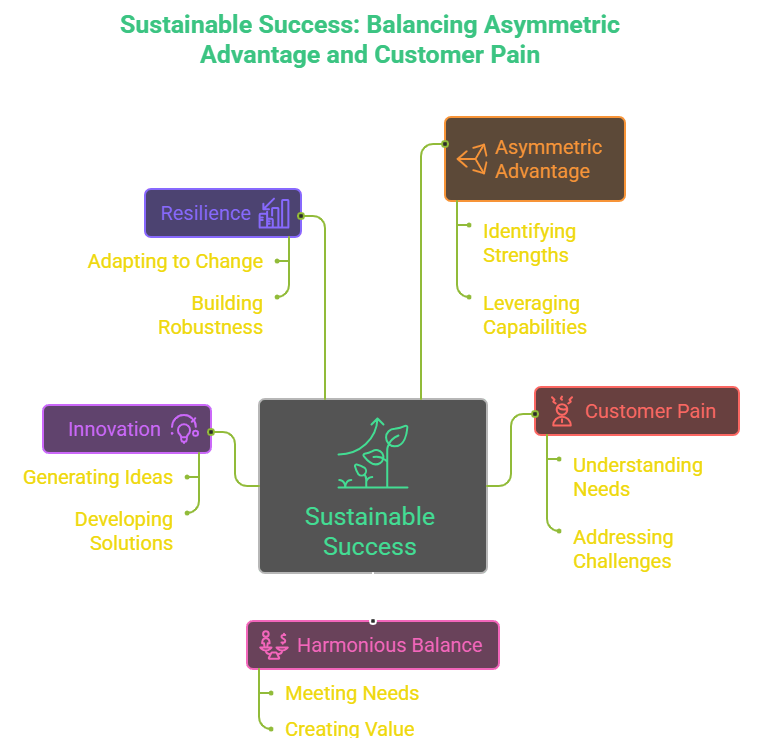
The real magic happens when both overlap.
Why Understanding This Early in Life Changes Everything
Many people spend years improving weaknesses instead of doubling down on strengths. Others ignore real-world problems and chase passion blindly.
When you understand this thesis early:
- You stop forcing careers that don’t fit you
- You make better decisions with less stress
- You start creating value instead of chasing validation
Life becomes more intentional—and less exhausting.
Why Businesses Fail Without This Understanding
Let’s be honest:
- Great products fail because they solve non-urgent problems
- Passionate founders burn out because they lack a real edge
A business grows only when:
A unique strength solves a painful problem at the right moment.
This is not theory. This is pattern recognition.
Indian Leaders Who Applied This Brilliantly
Dhirubhai Ambani
- Acute Pain: Indians wanted affordable access to quality goods
- Asymmetric Advantage: Vision, risk-taking, and distribution mastery
He didn’t just build a company. He changed consumer behavior.
Nandan Nilekani
- Acute Pain: Millions lacked official identity
- Asymmetric Advantage: System design and execution at national scale
Aadhaar became infrastructure—not a product.
Sridhar Vembu (Founder, Zoho)
- Acute Pain: Businesses needed affordable, reliable enterprise software without vendor lock-in
- Asymmetric Advantage: Deep engineering focus, long-term thinking, and operating away from hype
While others chased funding and rapid expansion, Sridhar Vembu focused on building strong products and nurturing talent from small towns. Zoho’s success came from solving a genuine business pain—high software costs—using a unique advantage: product-first culture and disciplined execution.
Ratan Tata
- Acute Pain: Unsafe family travel on two-wheelers
- Asymmetric Advantage: Ethical leadership and engineering scale
The Nano was empathy on wheels.
How You Can Apply This in Your Own Life (Reflection Section)
Take five minutes and reflect:
- What do people naturally come to me for help with?
- What problems around me create frustration or urgency?
- Where do my skills and their pain overlap?
✍️ Write the answers down. Clarity starts on paper.
Final Thoughts: Turning Insight into Action
Understanding asymmetric advantage without action is wasted insight. Observing customer pain without empathy is manipulation.
But when you combine:
- Self-awareness
- Empathy
- Timely execution
You create impact that feels meaningful—and sustainable.
Your Turn
👇 What is one strength you’ve been underestimating?
👇 What problem around you feels most urgent today?
Share your thoughts in the comment section below—your insight might help someone else find clarity.
📩 Please share this article with at least one person who needs this perspective right now.
📬 And if you haven’t yet, subscribe through the email Subscription Box at the bottom of the page to receive practical ideas that help you grow—in life and business.
Small clarity today can lead to massive impact tomorrow.
Stay tuned!!




 Wining Life & Business
Leave a comment