

Introduction
Imagine two people walking on a path—one holds a map, the other holds a compass. The one with the map knows where things are supposed to be. The one with the compass knows how to find their way when the path is unclear. Formal education is that map. Critical thinking is the compass. Now ask yourself—what’s more important? The answer isn’t either-or. It’s both.
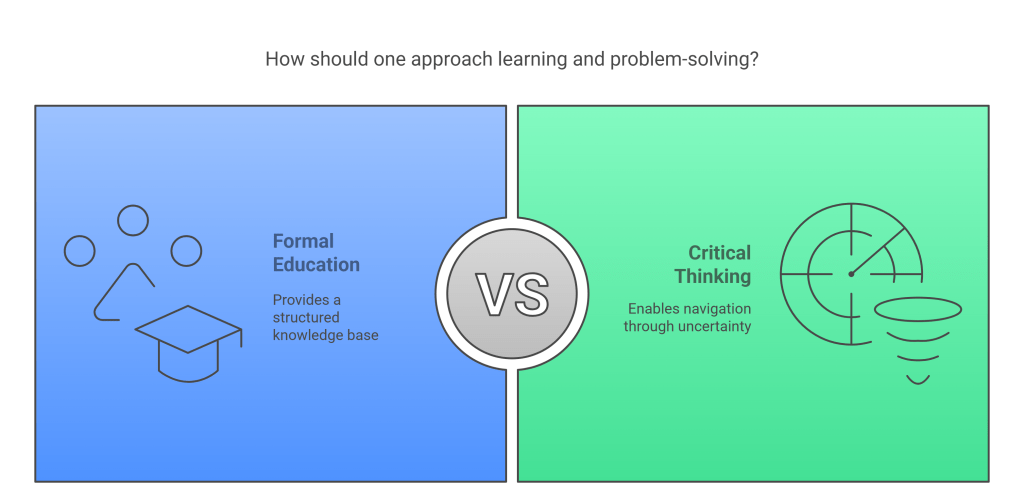
We often hear debates pitting formal education against life skills or real-world thinking. This blog isn’t about choosing one over the other. Instead, it’s about understanding how critical thinking enhances what we gain from formal education. It is a crucial life and business skill in today’s unpredictable world.
This journey will explore what critical thinking really means in simple words. It will show how it operates beyond the classroom. You will also learn how world-renowned leaders harnessed it. We’ll wrap up with a real-world action plan you can follow. It is applicable if you’re a student, professional, or entrepreneur. Or simply someone who wants to think better, live smarter, and decide wiser.
What is Critical Thinking?
A Simple Definition for Everyone
Let’s break it down. Critical thinking is the ability to think clearly, question deeply, and make reasoned decisions. It’s about pausing before reacting, asking “Why?” and “What if?” instead of blindly accepting what you’re told.
Think about this: when you face a difficult choice, like changing careers, what do you do? Do you simply follow what others say? Or do you ask questions, weigh the pros and cons, consider the risks, and make a thoughtful decision? That’s critical thinking in action.
It’s not about being a genius. It’s about being curious, thoughtful, and open-minded. It means looking at all sides of a situation before jumping to conclusions.
In simple words: Critical thinking is thinking smart—not just thinking hard.
Why Critical Thinking Matters in Everyday Life
Every day, we’re faced with decisions—big or small. Should I trust this news article? Is this job offer really what it seems? Should I confront my friend or let it go?
Without critical thinking, we just react emotionally or follow what others are doing. But when we think critically, we make informed, confident, and balanced decisions.
Here’s what it helps you with:
- Avoiding manipulation by asking the right questions.
- Making better financial decisions by evaluating options logically.
- Building strong relationships through thoughtful communication.
- Improving personal growth by reflecting on your beliefs and learning continuously.
Whether you’re a teenager choosing a college, or a parent raising kids, critical thinking enhances your journey. If you’re a retiree exploring new hobbies, it also enhances your journey. It makes your path smoother. Your vision becomes clearer, and your actions wiser.
What is Formal Education?
The Structured Path to Knowledge
Formal education is what most of us experience growing up—schools, colleges, universities, diplomas, degrees. It’s the system that gives us structure: subjects, textbooks, teachers, exams, and classrooms.
It builds our foundation:
- We learn math, science, language, history.
- We understand discipline, routine, deadlines.
- We develop communication, teamwork, and time management.
In short, formal education equips us with tools and information. It gives us the map to navigate the known world.
The Strengths of Formal Education
Let’s give credit where it’s due. Formal education has shaped millions of lives:
- It opens doors to jobs.
- It teaches basic logic and analytical thinking.
- It introduces diverse ideas and cultures.
- It nurtures creativity through art, science, and literature.
For many, formal education is the first step to independence, critical thinking, and discovering one’s passions. It teaches us how to learn, and in many ways, it sets the stage for deeper, lifelong learning.
The takeaway? Formal education builds your base. Critical thinking helps you build on it.
Critical Thinking vs. Formal Education: A Complementary View
Not Either-Or, But Both-And
Now, let’s settle the debate. Should you rely on formal education or embrace critical thinking?
The answer is: you need both.
Formal education gives you content. Critical thinking teaches you context. For example:
- A textbook can tell you the theory of economics, but critical thinking helps you analyze a crisis.
- A course can teach grammar, but critical thinking helps you write meaningful stories.
- A degree can earn you a job, but critical thinking can help you innovate in that role.
They are partners in progress—formal education feeds your brain; critical thinking feeds your growth.
Where Formal Education Stops and Critical Thinking Takes Over
Once you step out of the classroom, things get messy. Life doesn’t follow textbooks. Business problems aren’t always multiple choice. Relationships aren’t graded.
This is where critical thinking takes center stage. When faced with tough choices, conflicting opinions, ethical dilemmas, or uncertain futures—your thinking skills matter more than your academic scores.
And here’s the truth: Most of the challenges you’ll face in life and business won’t have clear answers. Critical thinking helps you thrive in those grey areas.
The Real-World Relevance of Critical Thinking
Thinking Outside the Box
Ever faced a situation where the usual solution just didn’t work?
That’s where thinking outside the box kicks in—one of the core traits of critical thinking. In real life, we often deal with ambiguous, complex, and emotionally charged issues. These aren’t problems with neat, textbook answers. They need creative, analytical thinking.
Example: Imagine a small business owner facing a sudden drop in sales. A traditional approach is slashing prices. But someone applying critical thinking will dig deeper:
- Are customer needs shifting?
- Is there a better way to deliver value?
- Strategic partnerships help?
This shift in thinking often leads to innovative and effective solutions.
Quote to Reflect:
“Education is not the learning of facts, but the training of the mind to think.” — Albert Einstein
Pause & Reflect:
- When was the last time you solved a problem in an unconventional way?
- Do you find yourself questioning routines or just following them?
When Textbooks Fall Short
Formal education doesn’t prepare you for everything—especially not the unpredictable moments of real life.
Real-Life Scenarios Where Critical Thinking Wins:
- Career decisions: Choosing passion over paycheck or vice versa.
- Parenting: Every child is different. No book can teach you how to respond in every situation.
- Health decisions: Understanding medical options instead of blindly following advice.
In these moments, critical thinking bridges the gap between knowledge and wisdom.
Quick Summary with Bullet Points: Critical thinking helps you:
- Analyze beyond surface-level data
- Respond to real-time feedback
- Balance emotion with logic
- Consider multiple perspectives before acting
Stories of Successful Leaders and Thinkers
Elon Musk – Questioning the Norm
Elon Musk didn’t revolutionize electric cars, space travel, and AI by accepting the status quo. He used first-principles thinking, a form of critical thinking that breaks problems down to their core truths.
Case Study Snapshot:
- While others compared electric car costs to gas cars, Musk asked: What are the actual costs of raw materials?
- Instead of asking how to build like others, he asked: What if we build everything in-house?
This thinking led to Tesla’s innovation in battery tech and production efficiency.
Oprah Winfrey – Embracing Perspective
Oprah’s story is a testament to empathy, self-awareness, and perspective—all vital parts of critical thinking.
Despite a troubled upbringing, she became a global voice by consistently asking:
- What is the deeper meaning here?
- How can I help people feel seen and heard?
Why it Matters: Critical thinkers aren’t just smart—they’re emotionally intelligent. Oprah’s success came not from formal education alone, but from her ability to read between the lines of human behavior.
Quote to Reflect:
“The greatest discovery of all time is that a person can change their future by merely changing their attitude.” — Oprah Winfrey
Steve Jobs – Redefining Possibilities
Steve Jobs didn’t invent computers or phones. He reimagined how people interact with technology. That’s visionary thinking—built on observation, insight, and courage.
Think about this:
- What if your phone had only one button?
- What if fonts could express your personality?
These weren’t questions found in engineering books. Jobs’ legacy was born from deep observation, aesthetic sensitivity, and questioning the ordinary.
Pause & Reflect:
- Are you asking questions no one else is asking?
- What part of your life or business can be redesigned through better thinking?
Critical Thinking in Business
Making Smarter Business Decisions
In business, decisions have consequences—financial, ethical, and personal. Critical thinking allows leaders to:
- Weigh short-term wins vs. long-term impact
- Detect biases in market research
- Challenge flawed assumptions
Real-World Example: During the 2008 recession, many companies cut costs through layoffs. But Howard Schultz, CEO of Starbucks, reopened closed stores and reinvested in staff training. His decision was based on long-term thinking—not panic.
Result? The company recovered stronger and faster.
Quick Checklist for Smarter Business Decisions:
- Ask: What’s the root cause?
- Examine: What data supports this?
- Consider: What are the unintended consequences?
- Invite: What do others think that I might be missing?
Building Resilient Teams
Teams built on critical thinking are more agile and innovative. Leaders who foster critical thinking:
- Encourage debate, not blind agreement
- Promote autonomy in problem-solving
- Create a safe space for ideas to be challenged
Bullet Points: Benefits of Critical Thinking Teams
- Fewer blind spots
- Higher accountability
- Greater adaptability
- More innovation
Quote to Reflect:
“The function of education is to teach one to think intensively and to think critically.” — Martin Luther King Jr.
Pause & Reflect:
- Does your team feel safe to question your decisions?
- Do you celebrate curiosity as much as productivity?
I truly hope you found the reading enjoyable and engaging. Your thoughts and feedback mean a lot to me. Please feel free to share them in the Comments section below. If you believe this article benefit others, I would be grateful if you share it within your community. If you haven’t had a chance to subscribe yet, please join our email list. You can do so through the subscribe box at the bottom of the page. Thank you for being part of this journey!
Stay Connected!!







 Wining Life & Business
Leave a reply to Raja Paul Cancel reply